
Friday, 13 November, 2026
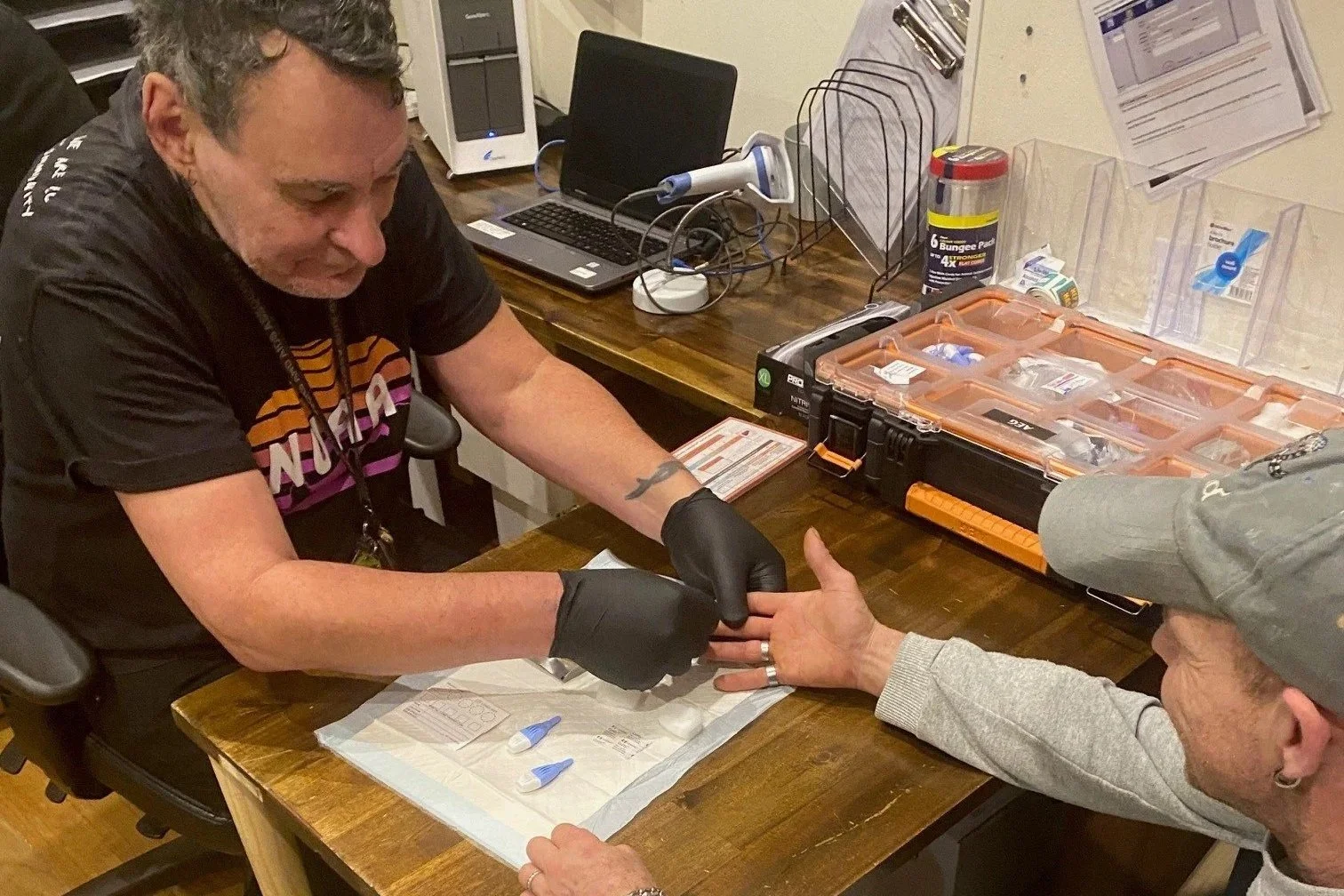
If you’ve walked through a park in inner Sydney lately, you might have spotted a NUAA table set up next to the other services. Behind it, more often than not, is Tony.
Tony is a NUAA outreach worker, blood borne virus (BBV) specialist and Hep C point of care operator. Regular readers might remember him from our World Hepatitis Day Q&A, where he shared his own journey with Hep C.
This time, we asked Tony what outreach looks like, what people ask him most, and what all those acronyms mean.
How would you describe what you do to someone who has never used an outreach service before?
I work within my own community of people who use drugs. And in my own capacity, I offer healthcare. That takes the form of testing and treatment.
At the NSP we used to do a lot more referrals. We don’t do that so much anymore. It is just testing. But in saying “just testing”, it’s a huge thing for people to be able to tick that off their box of junk that we all carry around.
I engage people on the street or in the park, which means walking up to complete strangers, asking them if they know about Hep C, answering questions if they have them and inviting them to be tested.
You’re also a point of care operator. What does that involve?
It means that if you test positive on an antibody test, I can do a PCR [polymerase chain reaction, more on that below] test and see if you have active, live virus. So whether you have active Hep C or not. And then we can treat it.
The Point of Care Testing (PoCT) machinery is heavy and cumbersome and has to be lugged around everywhere. It also has to be calibrated twice a month. So that’s also what I do, and I love that I’ve been trained to do that.
It's really amazing, and that's the thing I love about my job. I’d love to be an example to other peers that we can do anything. We can be trained to learn the most amazing things. I wouldn’t have thought that I could do this, but now I’m doing it. If that can inspire people, that would be fantastic.
How long does it take to get results?
The antibody test takes about five minutes. If that comes back positive, the PCR takes about an hour. People either hang around, or they come back, or we get their phone number and call them. It’s a bit different in rural areas, where we usually take a phone number.
It’s not only people who test positive on an antibody test who get a PCR, either. If somebody’s already had Hep C before and done the meds, we’ll put them straight through to PCR, because they’re not going to pass an antibody test.
What does a typical day on outreach look like, if there is such a thing?
In local outreach around the city, it’s usually me and another person. NUAA colleague Louise and I set up a table at a hub, which is a point where other services come to support people who are homeless.
We set up our table with our NUAA posters and some giveaways, anything that will attract people to our table and let them know who we are. Then we spend the day testing people, either at the table or in the St Vincent’s bus when that’s there, which is much more comfortable for the participant.
If it’s a windy day, it can look pretty messy! We’re literally in the park doing testing on a table, and it’s great fun. People tend to enjoy it.
What would you say to people who are worried about privacy, or about being seen using the service?
It can be a little difficult, I admit. At the NSP, it was a lot more private.
We do have one specific day a fortnight where we test on the bus, at Green Park, and it is a lot more private. So I would encourage people who'd prefer a little extra privacy to come and see us at Green Park.
Outreach in rural areas is a bit different. We have a pagoda, and it’s a lot more private. Sometimes we’re in doctors’ offices or hospitals and we have our own rooms, so that’s a lot easier.
How do you build trust with people who may have had negative experiences with health services?
It’s really difficult. I disclose quite a bit, where I can. And we talk about coming from a peer-based organisation. We make that pretty clear. We’re not the usual health system that people work within.
Then I guess it’s about offering some empathy. People respond to empathy, naturally enough. That’s the best way to gain trust, I think, to listen and connect with the person.
Are there more challenges doing outreach compared to testing at the NSP?
At the NSP, we had a chance to spread it out and talk about a more holistic version of what the person needed. Doing outreach, I don’t get the opportunity to do that so much anymore, and that’s something that needs to change, I think, because we need to be able to connect with our consumers. We only have a limited amount of time, and there’s usually a queue of people waiting. We’re popular where we go!
A lot of people are quite defensive when they come to us, because they think they’ve got to jump through hurdles to get tested or get the incentive. We break that down pretty quickly.
What do people ask you most often?
People are often very confused about antibody status. People often think they are immune to Hep C.
People also want to know who we are and where we come from, as an organisation, which is really interesting. For me, that’s as a person too, because I’m a peer.
Sometimes people have pretty valid questions about what we do with their information. We take the time to explain that we keep their information for seven years, and that it’s [de-identified] and locked up, out of sight. It’s not used for anything [else]. Let me make that really clear, that’s really important. We really go out of our way to explain what the study with the Kirby Institute is, what it means when you sign a bit of paper, and what happens to that paper.
Some people are a bit funny about the testing itself. It’s only a finger-prick test, but I guess some people have been hurt a lot. They’ve had a lot of pain, and that tiny bit of pain causes a lot of anxiety. Usually we’re able to talk people through it. I tell them it feels like a rubber band being flicked.
Generally, though, we don’t get any questions that shock me, or that I haven’t heard before.
Are there common misconceptions about Hep C testing or treatment?
The old interferon idea has kind of gone to the background now. People are not so concerned about that. I think the news is out about the new medications, or everyone knows someone who’s done it. So that’s really good.
People don’t come with questions about stigma, but it comes up a lot. People often liken Hep C to HIV, except they don’t say it like that. They say AIDS. So I talk about language, and I have disclosed my own status as living with HIV.
I think it’s really important to talk about stigma when it comes up, because people are in a community where stigma hurts. Usually when people use stigmatising language, it’s internalised, so it makes way for a great conversation, a great segue into where they’re coming from. Most of our engagement and conversations are organic.
Is there anything people are surprised they can get from outreach?
People are often really surprised that we have injecting equipment. And people are often really excited when we mention vein care. People can talk about their veins, and we can talk about that with them.
People are often really pleased when they realise that we understand what they’re talking about, and that we can have a conversation with them, as opposed to telling them something. It’s not cold and clinical. We’re not cold.
We also carry naloxone. We give it out when people ask for it. If somebody wants naloxone but doesn’t necessarily want to be tested for Hep C, they can always come and see us when we’re out doing outreach. Same with syringes. If somebody wants equipment, they can come and see us. It doesn’t mean they have to have a test. They’re not locked in.
What’s the most important thing you’ve learned from doing this work? What do you find rewarding?
I’ve had some really profound reactions from people during and after testing, people who wouldn’t normally get tested. And I’ve found the power of connection. I always sort of knew that, but in practice, the power of connection and engagement.
I don’t feel like I get to do as much engagement anymore. It’s testing, testing, testing. But I still have those moments where I realise the power of engagement. It changes someone’s life, or their trajectory, or their momentum.
This awesome person said the most inspiring thing to me just after we became able to hook people up with DAA’s. I’d engaged them several times and told them what I do and what we might be able to do for them. They were scared. They had an idea they were living with Hep C but they were scared.
Then one day they surprised me by taking me up on a test and subsequently treatment and cure from Hep C. I remember them being incredibly generous in letting me, and even enjoying me in my role. They were really funny and they let me be funny too.
I remember that whole passage in my life happily. One day they looked me in the eye and said I’d changed their life. I’d made a difference. But the thing about engagement is that it’s a two-way street. This person trusted me enough to change their life. I can’t talk about the rewards of my job without talking about this.
And that’s something we’ve all got, I think. Peers coming in and wanting to work in drug and alcohol, or with NUAA, it’s something a lot of us have inside us, and we can access it. It’s weird to say that’s the most important thing I’ve learned, but it is.
If someone reading this has been putting off getting tested, what would you want them to know?
I’d want them to know that they’re in good hands. That it only takes 20 minutes, that we’ll go out of our way to make them feel comfortable, and that we’ll take care of them if they need treatment. And the treatment is so easy.
Anything else you’d like readers to know?
At the risk of repeating myself: we are peers, and we do go out of our way, when people come to us, to make them feel comfortable and to do our best. That’s what we do. That’s what we believe in. I don’t think there’s anybody in this job who doesn’t believe in working with and helping their community.
How can people find out where you’ll be?
Check out NUAA’s socials, on Instagram and Facebook. There’s always an update on where we’ll be.
Cheers, and with love from Tony.
RNA, PCR: What Do They Actually Mean?
We hear these acronyms all the time when we talk about Hep C and Hep C testing. I’m a peer support worker, and I test peers for Hep C. I think knowledge is powerful, and so I’m going to explain my own basic understanding of RNA and PCR as they relate to testing for hepatitis C.
RNA
RNA and DNA live in every living cell. Every living cell also contains little assembly shops, or ribosomes, which work to produce proteins. To do this, they need a very specific group of blueprints.
RNA delivers genetic data to these shops (ribosomes). Another job it does is to select the specific amino acids needed to build proteins. The two main types of RNA are messenger and transfer RNA.
While most genetic information, like our evolutionary history as well as our physiological journey from birth to present, is stored in DNA, some information, like the presence of viruses including hepatitis and HIV, is copied out from the DNA library and then becomes visible in RNA.
The fact that RNA lives in every living cell makes it very easy to collect from samples of blood and saliva. Also, technology today means reading a diagnosis from RNA isn’t only possible, but available and in use.
PCR
The other acronym we hear a lot is PCR, or polymerase chain reaction. A PCR test is one of the types of testing we do at NUAA.
PCR refers to the method of testing a blood sample for a specific virus. In our case, using a Point of Care Testing PoCT machine called a GeneXpert, we use it to test for Hep C.
We take a tiny sample of blood from your finger. The sample then goes into a cassette that goes straight into the machine. The cassette contains chemical reagents that, once activated in the machine, copy the genetic material contained in RNA millions of times.
Then, the machine uses light and colour to highlight specific viral tags or markers, thus identifying the live virus in a little under an hour.
More Jargon
Our sector loves an acronym. Here are some you’ll hear around Hep C testing and outreach.
Hep C (HCV): Hepatitis C virus. A blood borne virus that affects the liver. It’s curable.
BBV: Blood borne virus. Viruses passed on through blood-to-blood contact, like Hep C, Hep B and HIV.
Antibody test: Shows whether you’ve ever been exposed to Hep C. Antibodies usually stay in your blood for life, even after you clear the virus or are cured. Having them doesn’t make you immune: you can get Hep C again. A positive antibody test is followed by a PCR test.
RNA: Ribonucleic acid. Genetic material. Hep C’s own genetic material is RNA, so finding Hep C RNA in your blood means the virus is active.
PCR: Polymerase chain reaction. A test that copies any viral genetic material in a sample millions of times so it can be detected. It tells you whether you have live Hep C right now.
Point of care (POC): Testing done on the spot, wherever you are, with results the same day, rather than sending a sample off to a lab.
GeneXpert: The portable machine NUAA uses to run point of care PCR tests for Hep C.
DAAs: Direct-acting antivirals. The current Hep C medications. They’re tablets, and they replaced interferon, the older treatment many people remember for its harsh side effects.
NSP: Needle and syringe program. Where you can get free sterile injecting equipment.
Naloxone: A medication that temporarily reverses an opioid overdose. Free and available without a prescription. Available as a nasal spray or pre-loaded injectable.
Questions about any of these? Call PeerLine for free on 1800 644 413, Monday to Friday, 9am to 5pm (excluding public holidays).
Visit Tony and NUAA's outreach team fortnightly at Belmore Park on Mondays, and Green Park on Thursdays. Their next day at Belmore Park will be Monday 16th November, and Green Park on Thursday 26th November.