Drawing From Experience
Friday, 26 June, 2026
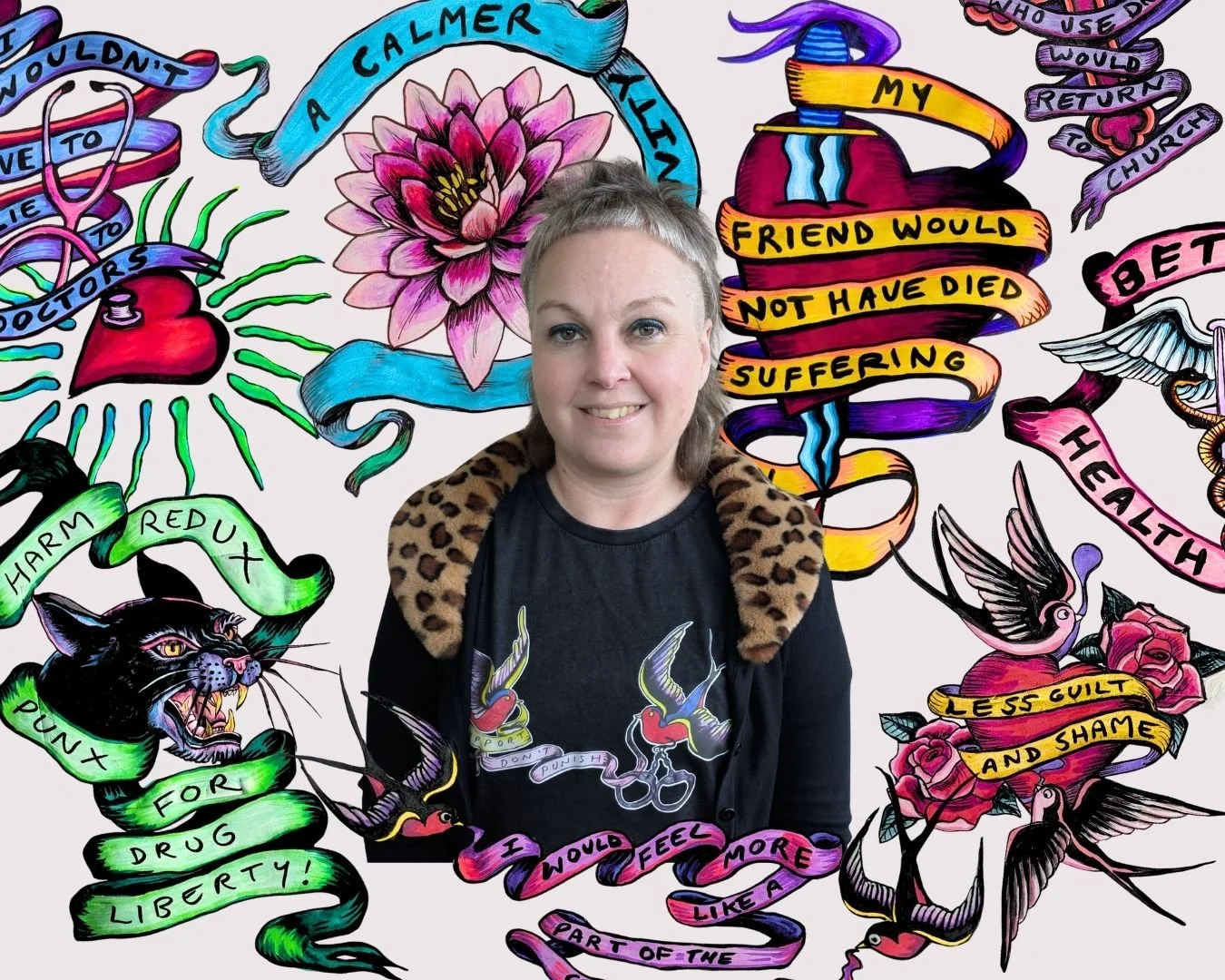
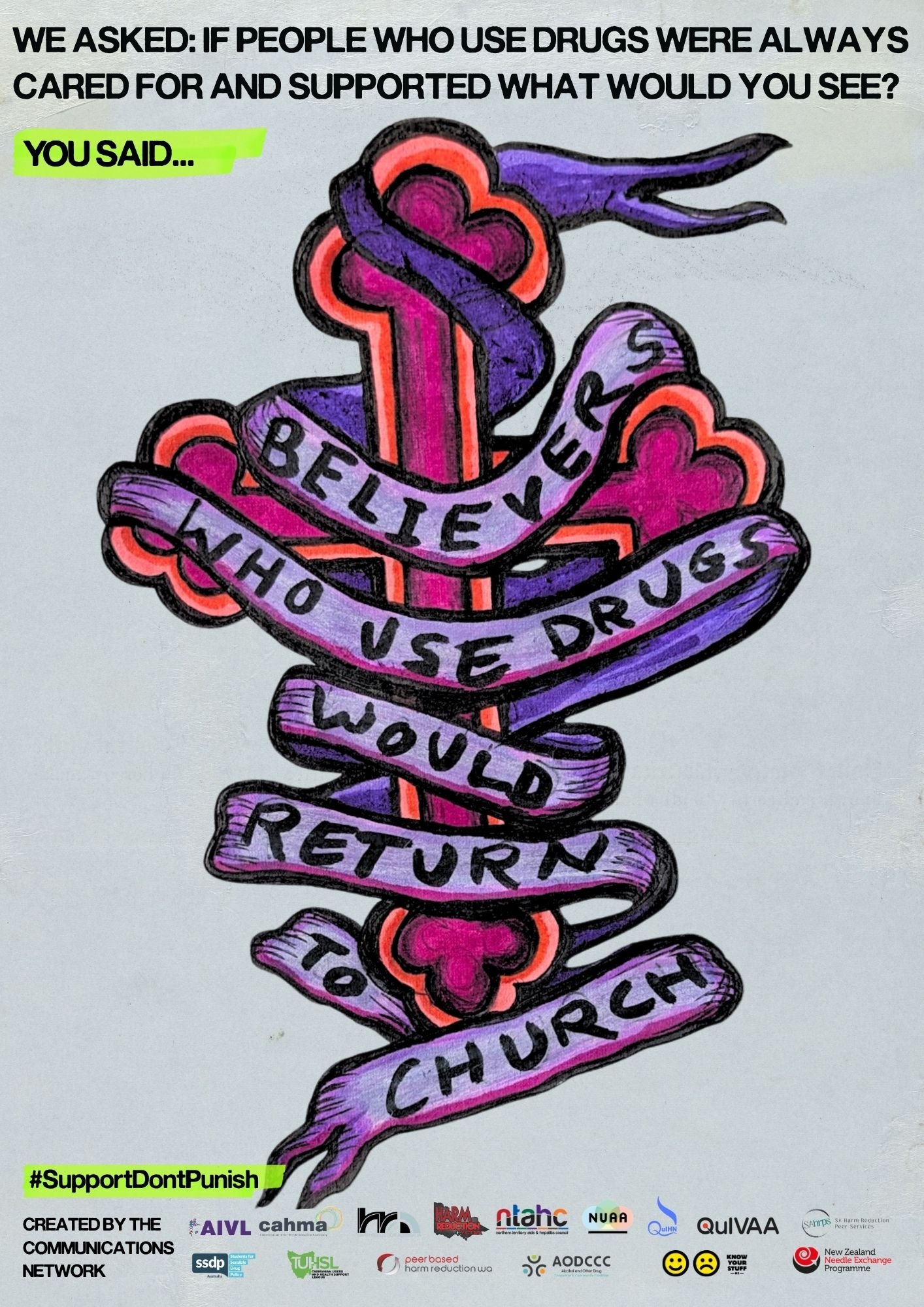
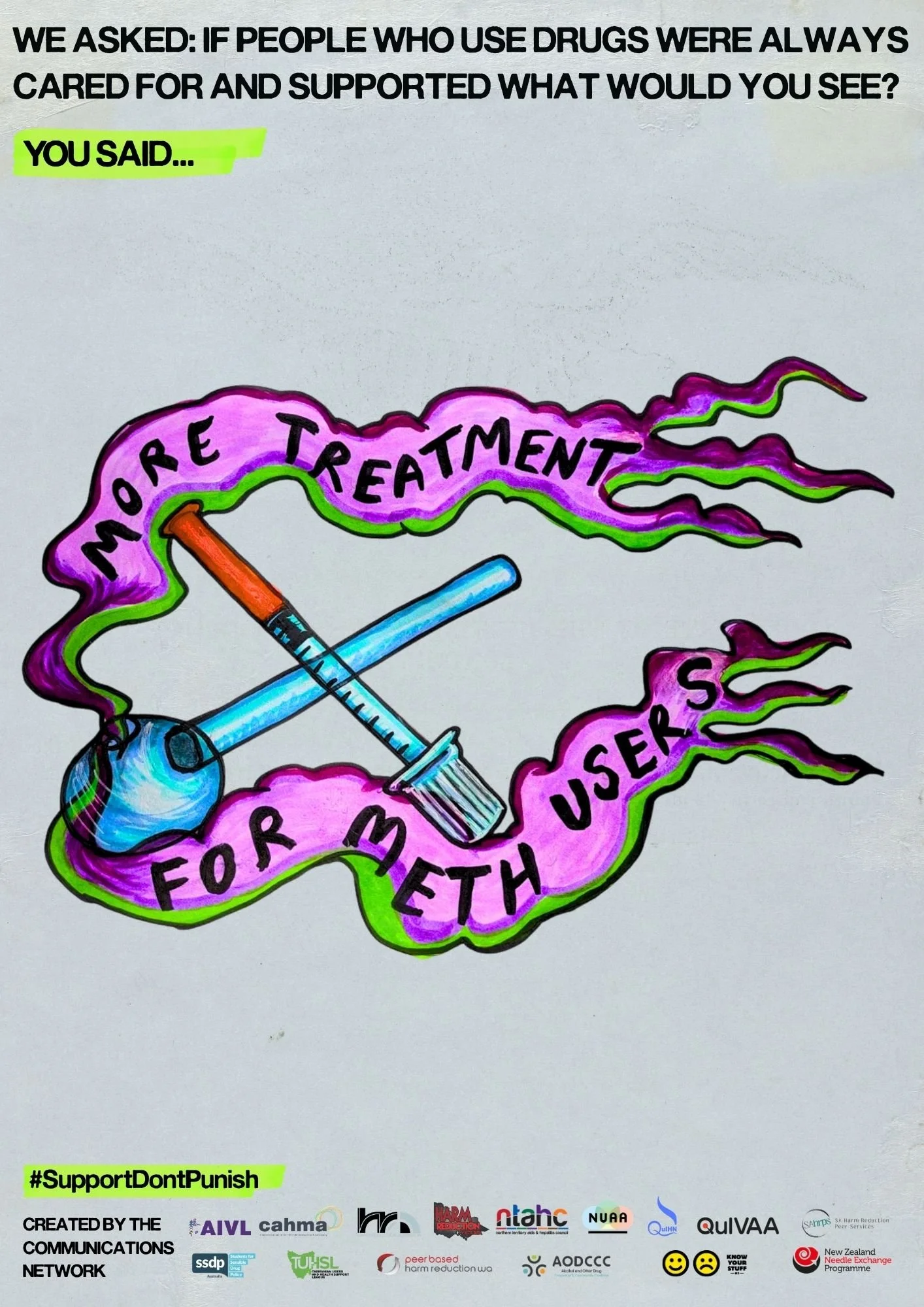
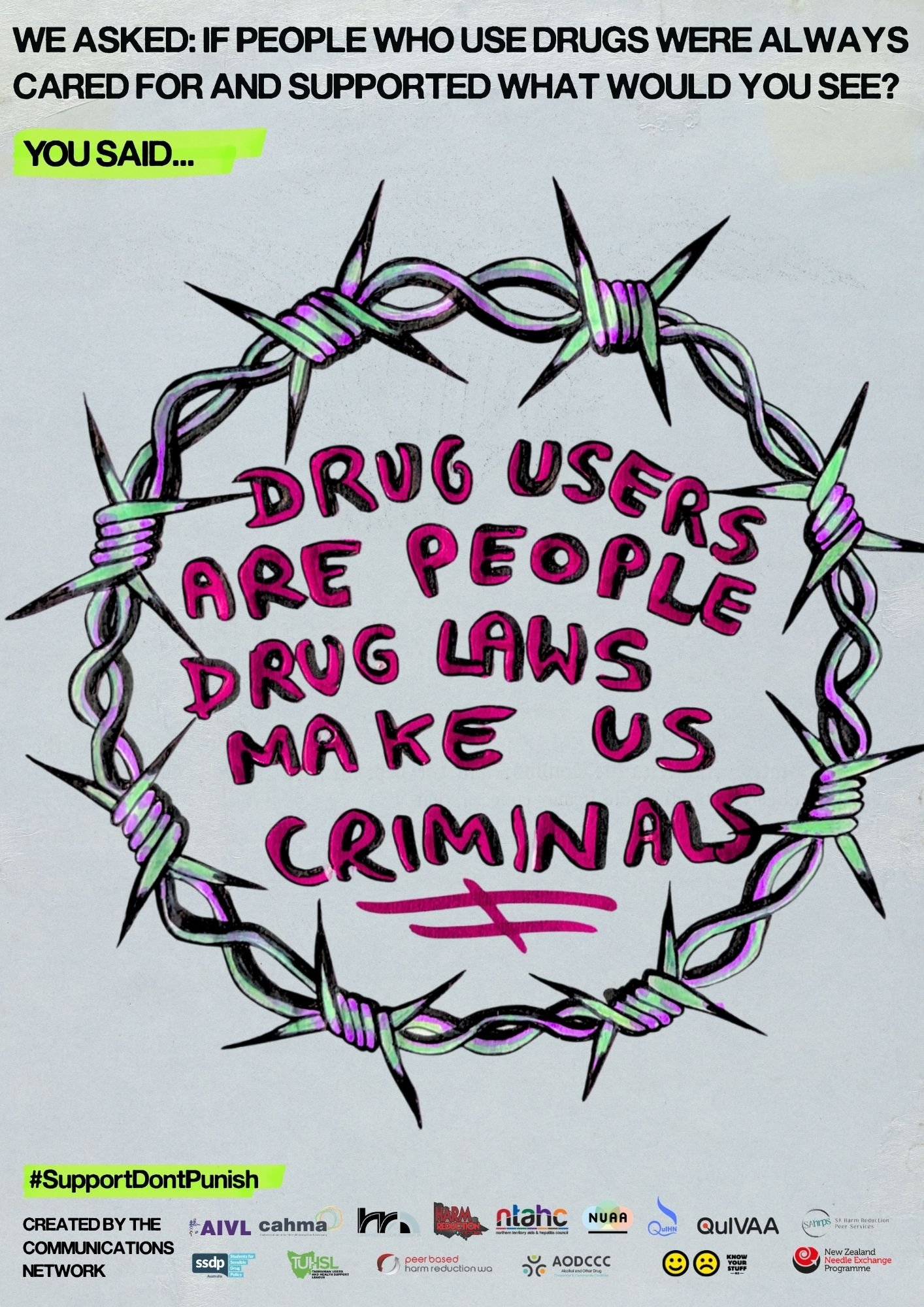
If you’ve ever seen the flash-sheet style posters for the Support Don’t Punish (SDP) campaign and thought ‘whoever made these really gets it’, you’d be right.
Behind the vivid tattoo-like illustrations is Emily Ebdon, artist, communications worker, and harm reduction peer who has spent the better part of her 20-year career on the frontlines of Needle and Syringe Programs (NSPs) across Tasmania.
Emily didn’t take a straight path to this work. She studied fine arts, laughing as she says “it’s always a bit of a joke, that it's not a degree where there's a career necessarily at the end.”
She begun her journey working in and managing NSPs, a sector she describes as chronically underfunded and getting tighter every year.
Despite the proud and groundbreaking history of Australia’s NSP network, funding has always been a struggle. NSPs have historically been run by a patchwork of providers, some community-based and peer-led, others overseen by larger health or faith-based organisations that don’t always understand or prioritise the culture of the people they’re serving.
On the ground, Emily experienced the effects of this tension.
“Things get tighter resource wise, you get several less posters and little things like that over the years” she says. At one point, she didn’t have access to a colour printer.
However, this gap in funding and resources gave Emily’s innovation and creativity room to shine.
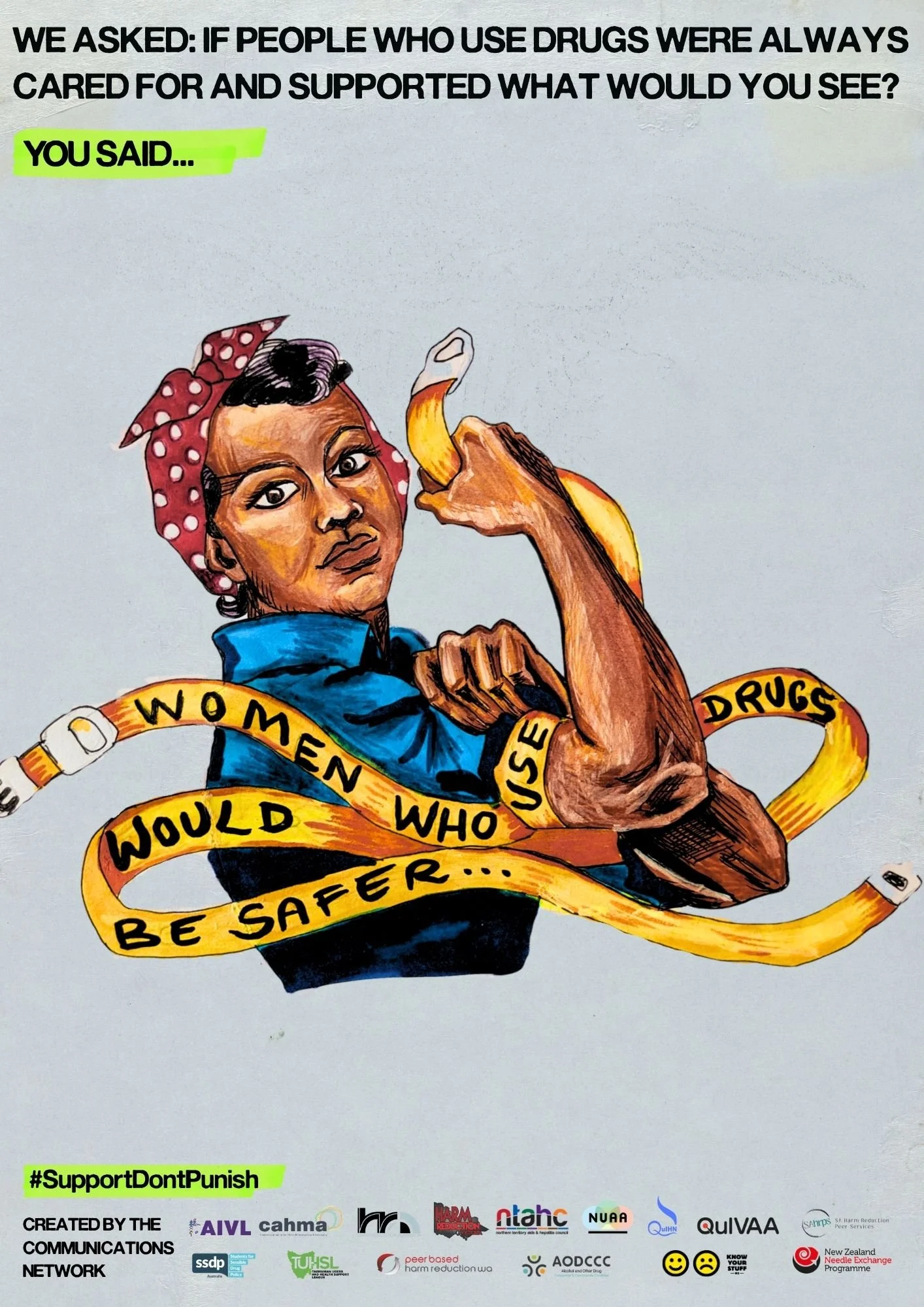
She started making her own posters – Rosie the Riveter holding a fit, the Queen with a speech bubble saying “it’s my birthday” informing service users of a holiday closure – bringing colour, humour, and humanity into spaces that needed it.
Working within a large, faith-based organisation often meant Emily’s creative instincts were reined in. Every flyer had to match corporate branding. Every poster had to go through approval.
"It became a little act of rebellion to do that, because I would get told off for it. Like, you’re meant to be following this thing, but I’m the one on the ground. They’re detached, they don’t know the NSP culture or people."
It wasn’t until she began working at INPUD, the International Network of People who Use Drugs that Emily found an environment where her instincts and creativity were valued, not suppressed.
"I didn’t feel like I’d creatively thrived until being in the drug user network or movement” she says.
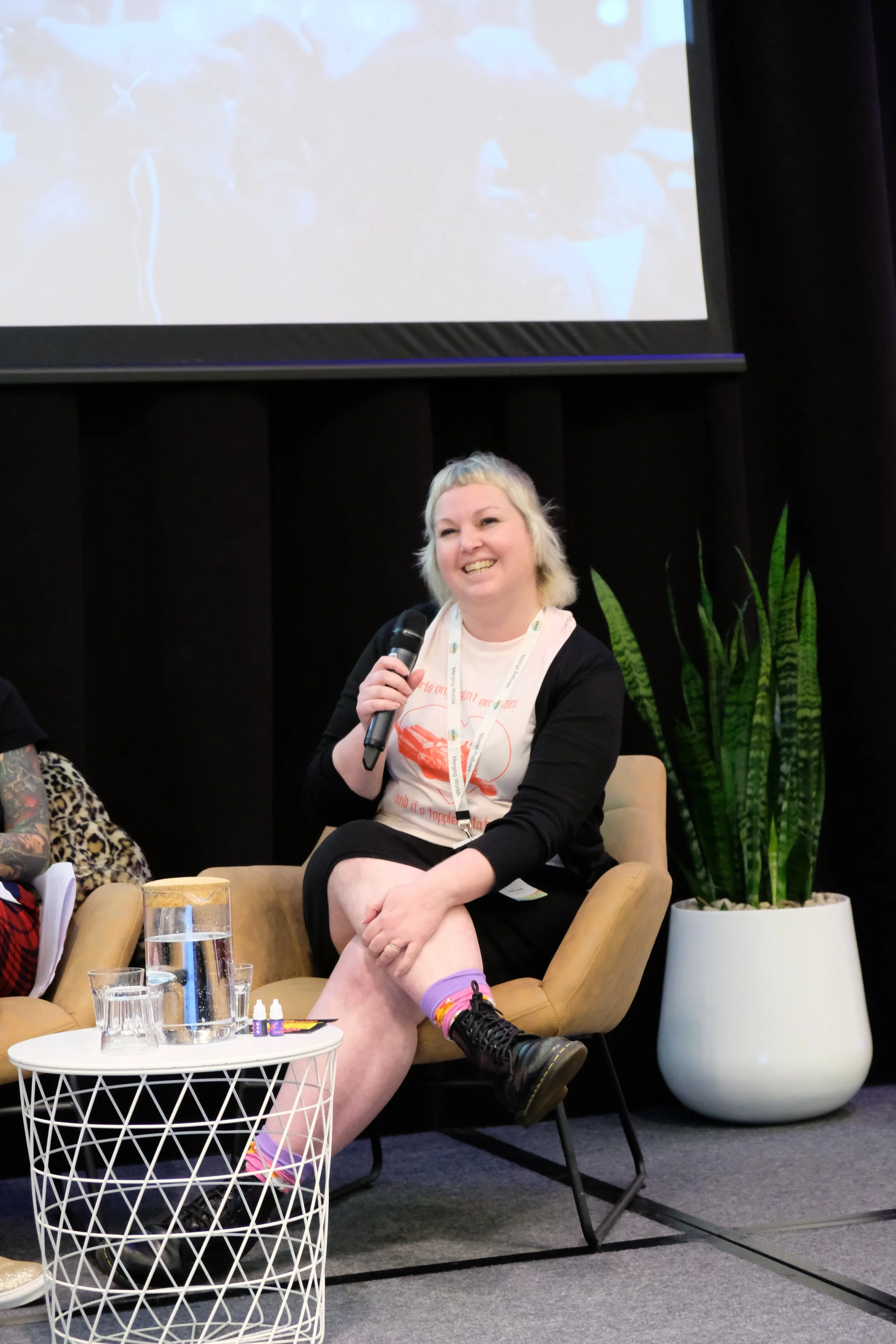
This continued when she joined AIVL, the Australian Injecting and Illicit Drug Users League, the national peer-led peak body for people who use drugs. Formed in the late 1980’s during the HIV crisis by people with lived experience of drug use, it now represents a network of peer-based harm reduction programs and drug user organisations (DUOs) across Australia.
As the peak body, AIVL advises the Australian Department of Health and Aged Care, develops peer workforce capacity, runs national campaigns, and advocates on drug law reform. Like the organisations it represents, AIVL operates on a principle that the people most affected by drug policy must be the ones leading the response.
Emily works in communications, and her role reflects AIVL’s broader approach: peer-created content, for peer audiences, led by people with genuine lived experience. It’s a world away from the standardised, corporate-approved flyers she was once told to produce.
Support Don’t Punish
Support Don’t Punish is a global grassroots campaign that calls for drug policies based on health and human rights, rather than punishment.
It was established in 2012 and held its first Global Day of Action in 2013 across 41 cities in 22 countries. By 2024, that had grown to over 291 cities in 84 countries. Every year, the campaign mobilises on or around June 26, the UN’s International Day Against Drug Abuse and Illicit Trafficking, to reclaim that date’s narrative from one of punishment to one of solidarity and care.
But Emily’s first encounter with the SDP campaign wasn’t exactly love at first sight. Working in a previous comms position, she was surprised to find that some peers in the sector had serious reservations about it.
The issue? SDP wasn’t a peer-led initiative. It hadn’t originated from the drug user community itself.
For some people in the movement, participating in a campaign they didn’t create felt like endorsing something that didn’t truly belong to them.
"I was really surprised. But I get it now, it’s not peer-led, it’s not a peer initiative. It’s not an idea that came from peers originally."
Emily carried that thinking with her when she moved to AIVL. That’s when Molly, AIVL’s director of operations and communications, helped shift her perspective.
"Molly’s so great. She has such a way where she can open your eyes and bring you along, and not do it in a way that gets you defensive or anything."
From that conversation, Emily came to see that the DUO network could take the campaign and make it their own.
Genuinely peer-led, peer-driven, and peer-created, even if the original idea wasn’t.
The key was how it was done. And for AIVL, that meant going directly to people who use drugs across Australia and asking them what they want the world to know.
The Creative Process
It all begins on the ground.
DUOs from across the country, through their NSP workers and peer networks, collect responses to a question posed to people who use drugs. Hundreds of submissions come in. Emily gets the full list, reads through every one of them, and chooses around 20 to turn into illustrations.
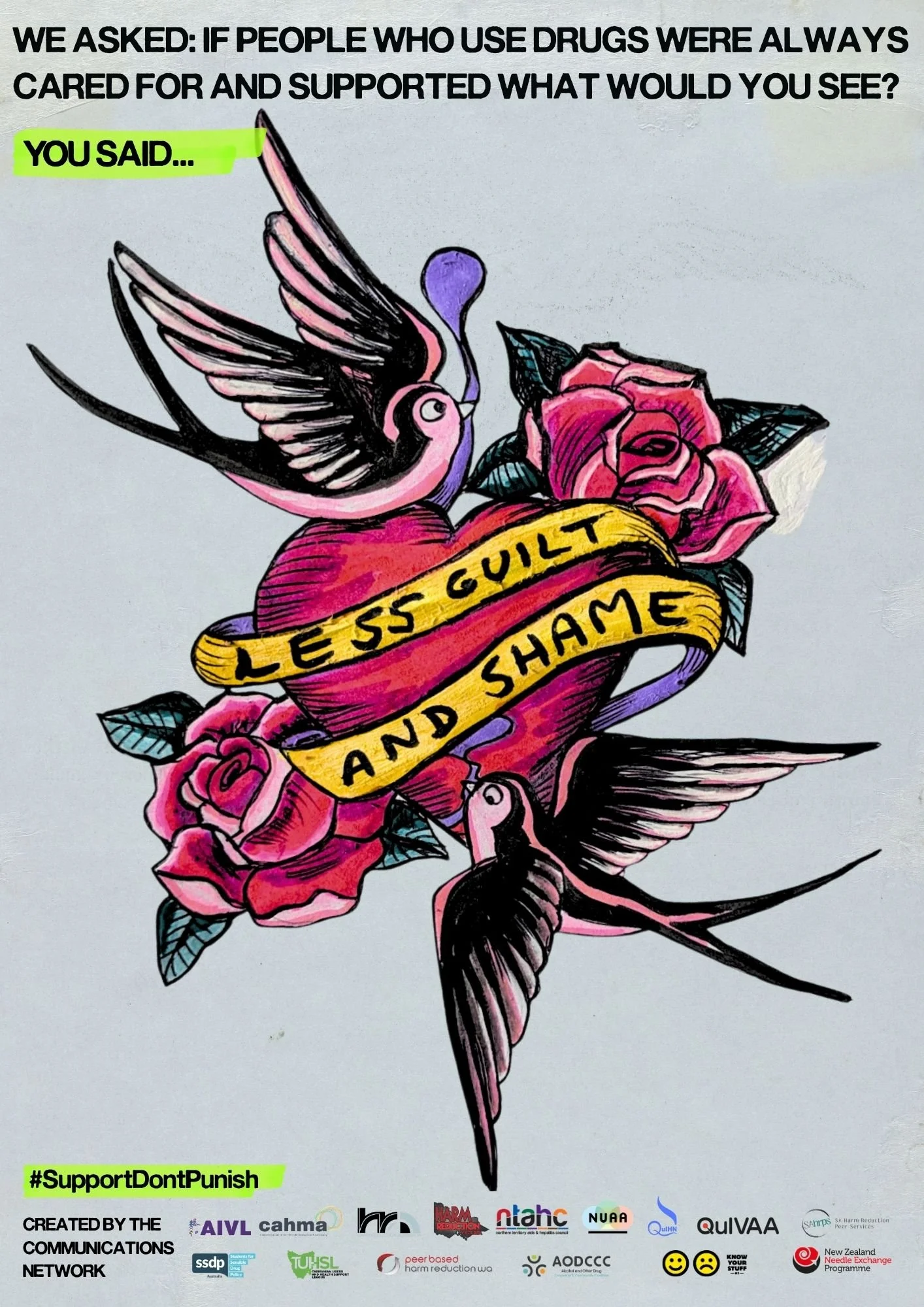
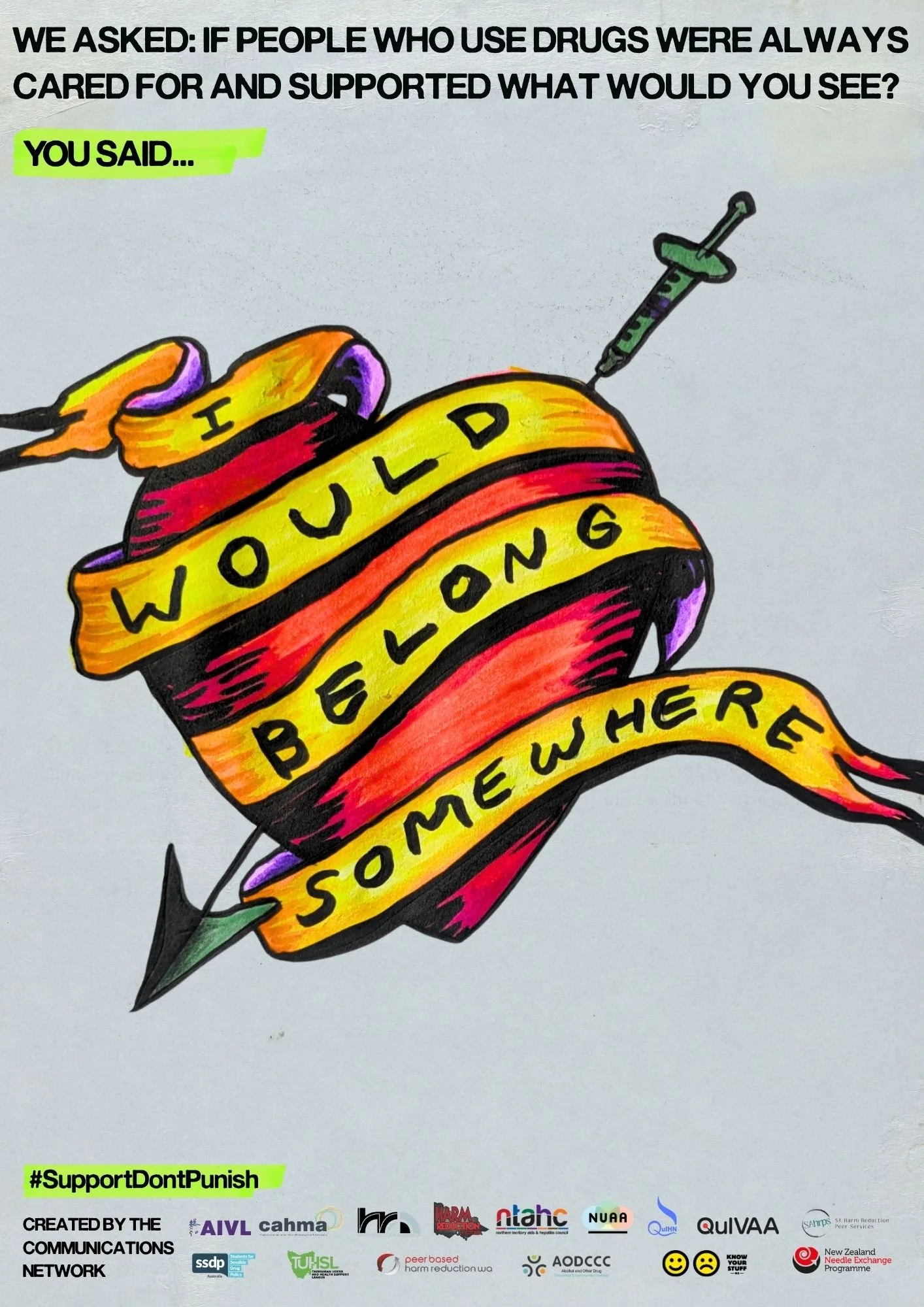
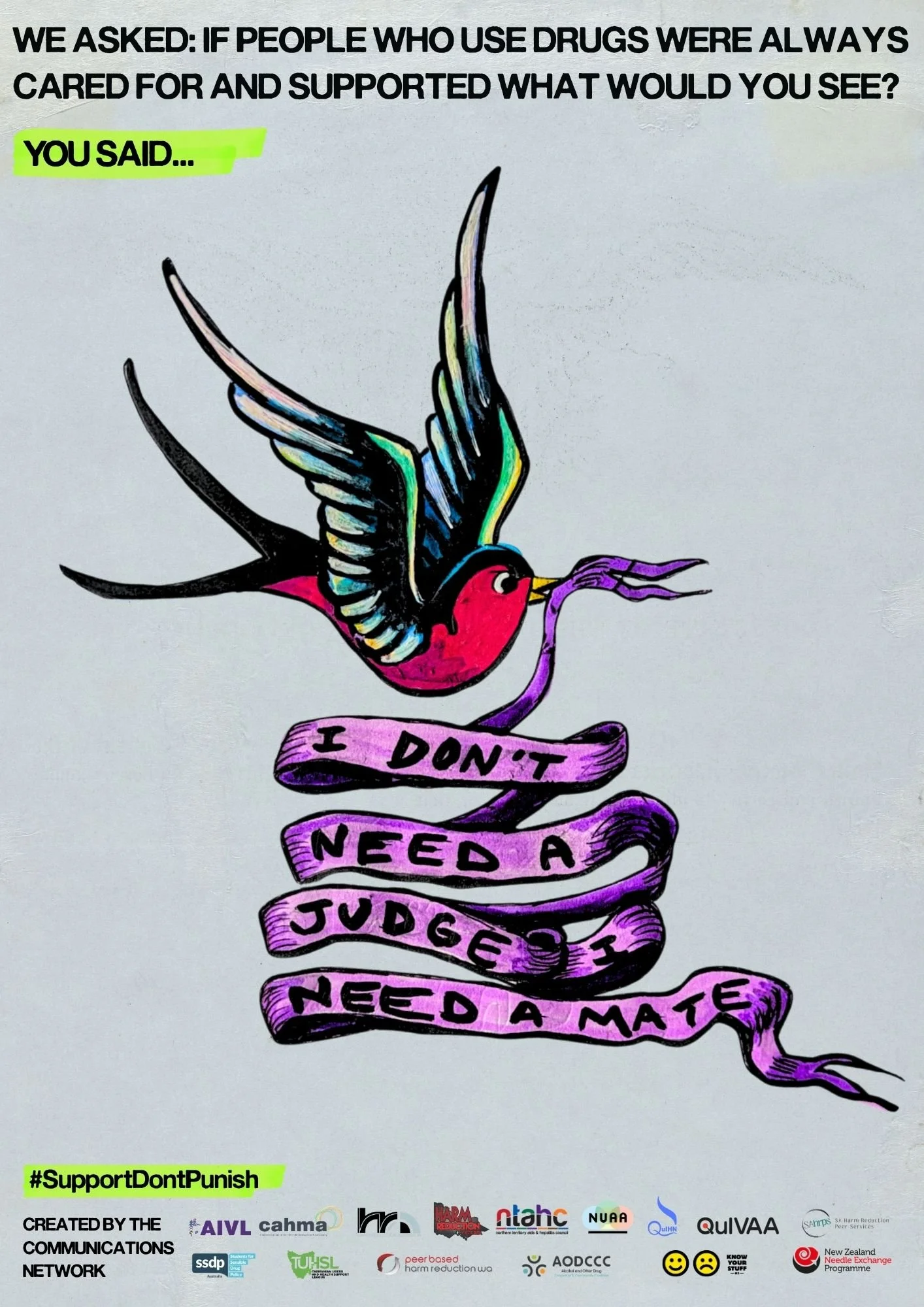
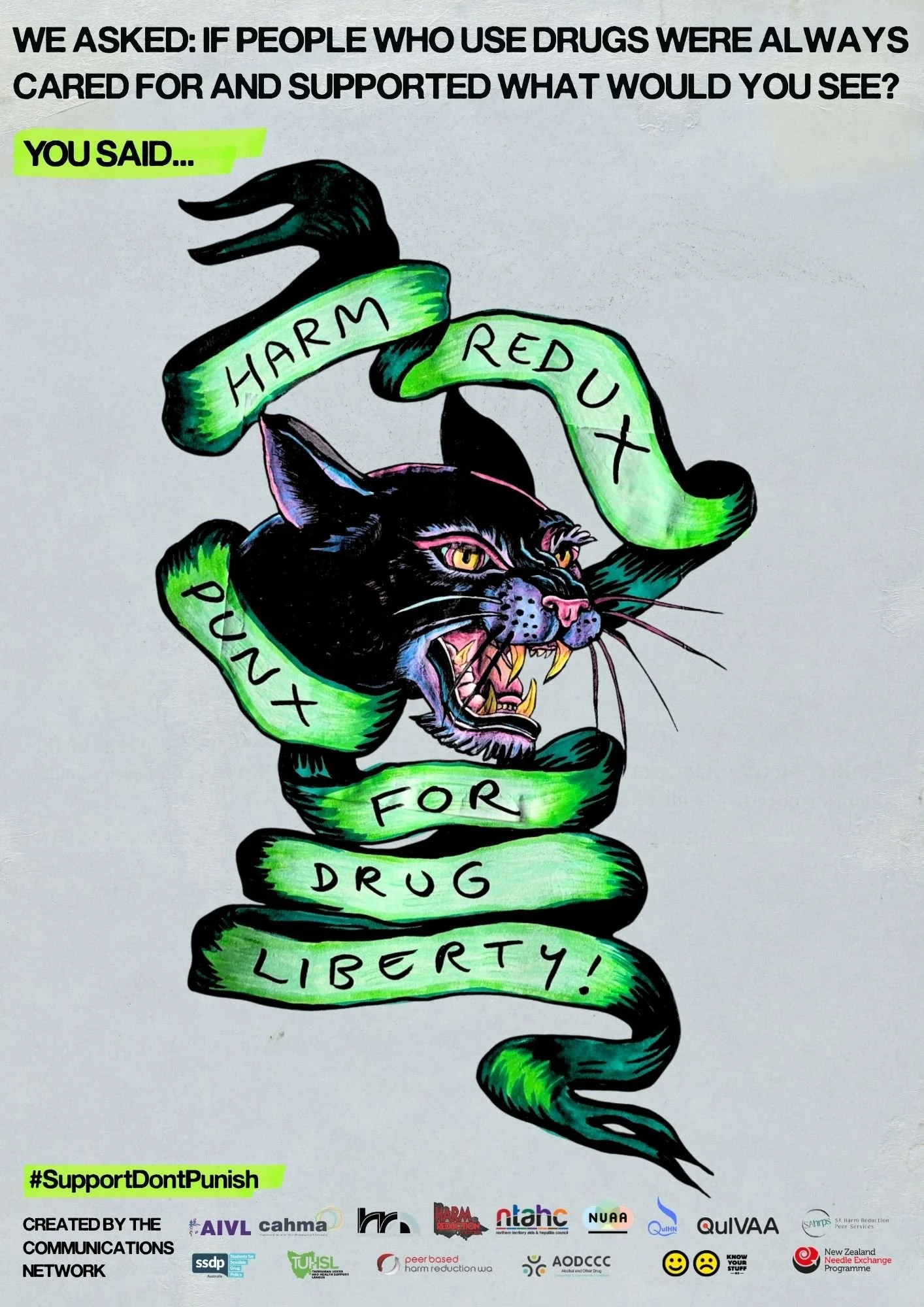
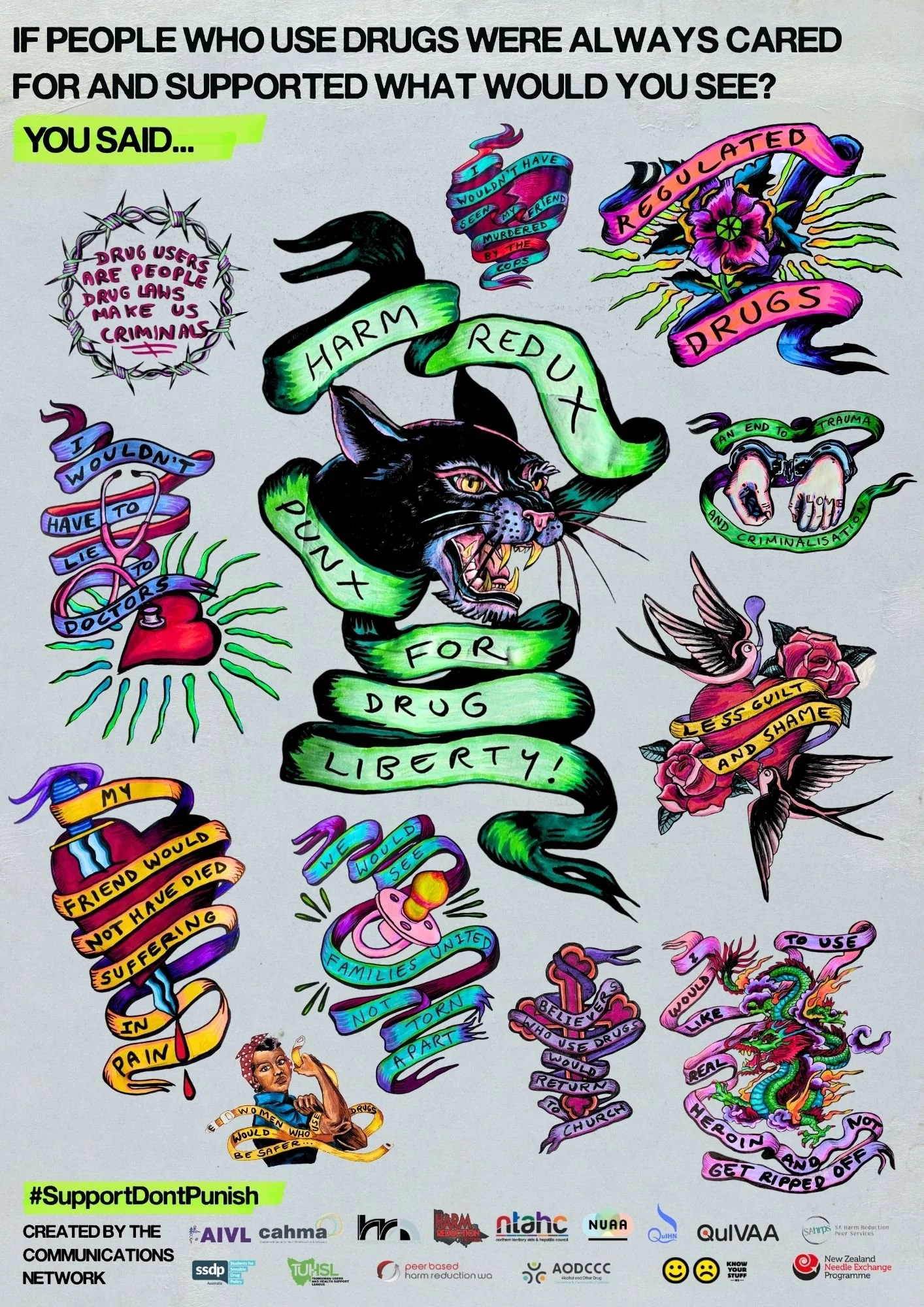
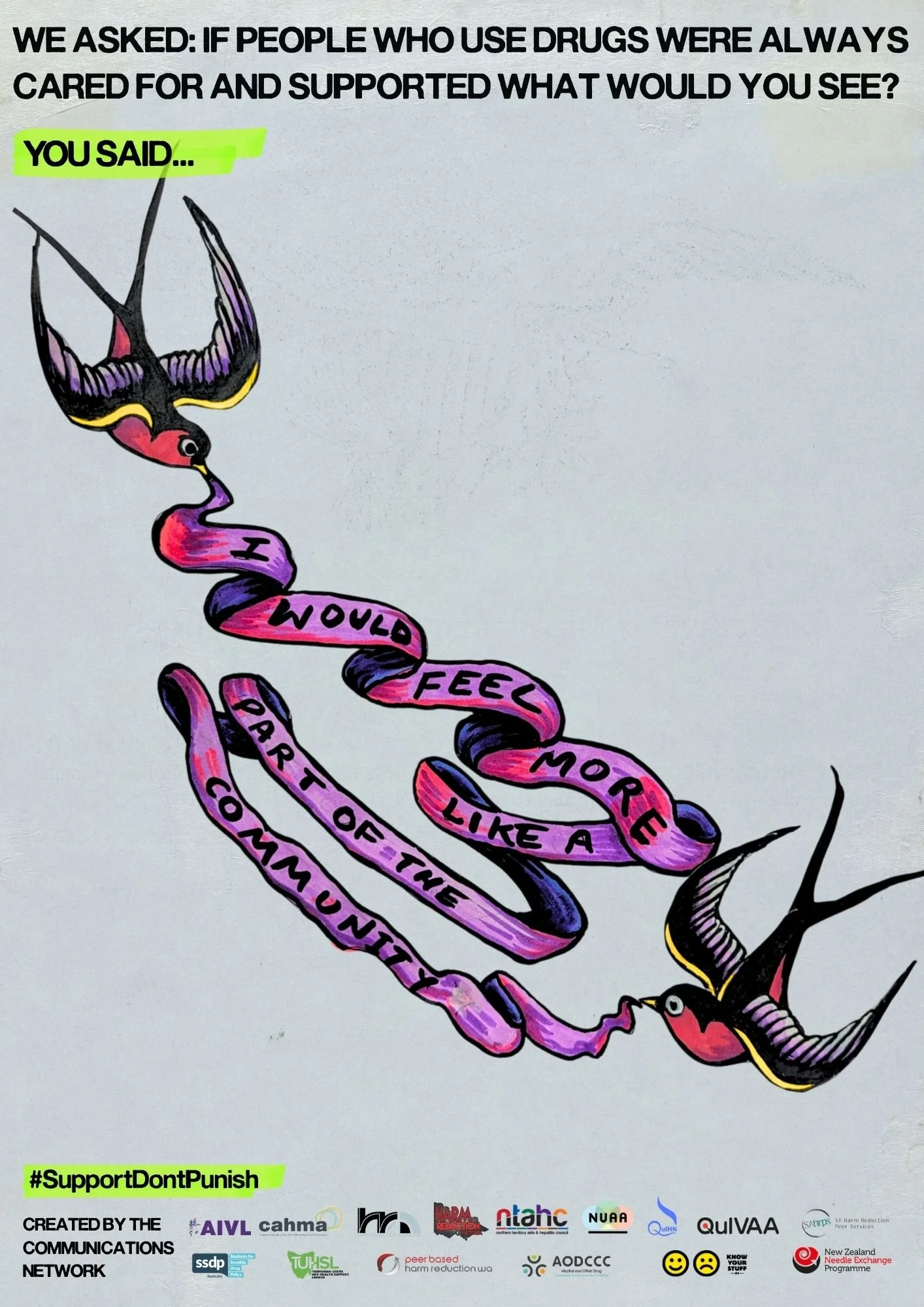
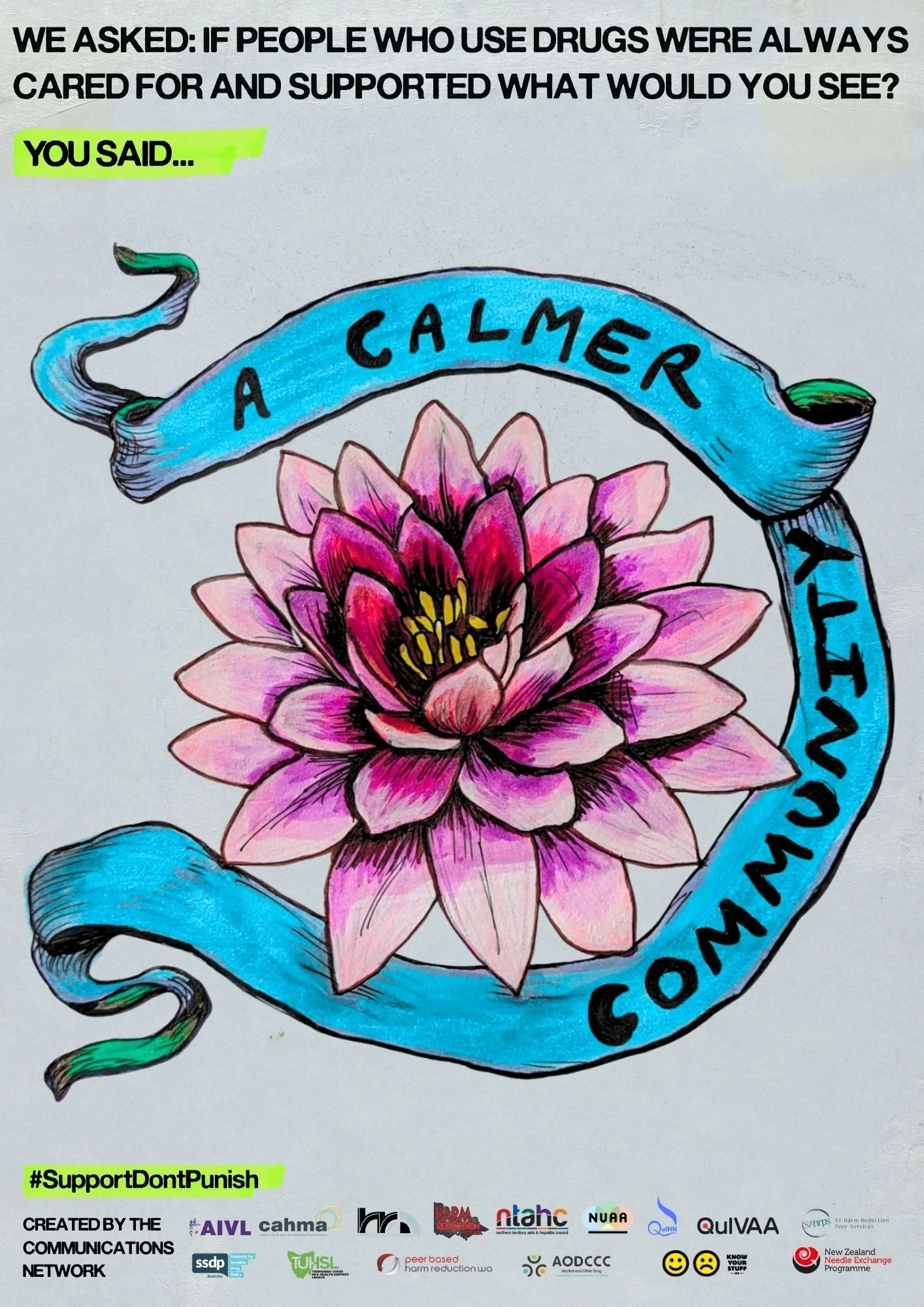
The visual style was Molly’s concept. Ed Hardy old-school tattoo flash, with the quotes sitting inside ribbon banners. Emily took the idea and ran with it.
"She gave me a very basic reference picture, a flash sheet of Ed Hardy, mainly all hearts with ribbon banners and some swallows. There were no other objects or imagery in there. So I started with that, working out a way to do that style, and do it all by hand."
Traditional tattoo flash art has its own visual vocabulary. Swallows, daggers, roses, anchors, banners, with roots in sailor culture and a history going back over a century. The Ed Hardy aesthetic that Molly referenced draws on this tradition but pushes it into bold, pop-art territory. Emily absorbed all of that and then started adding her own objects, led entirely by the quotes she was working with.
One submission mentioned urine-analysis drug testing, so she drew a urine specimen container. Another quote leaned into an anti-authoritarian feel, so she added a black cat, a classic punk and anarchist symbol that also suits the tattoo style perfectly.
“I’m the owner of a black cat myself called Avis, so anywhere I can weave a black cat into something – I do, to pay homage to my cat! Black cats are a symbol for Anarchy after all.”
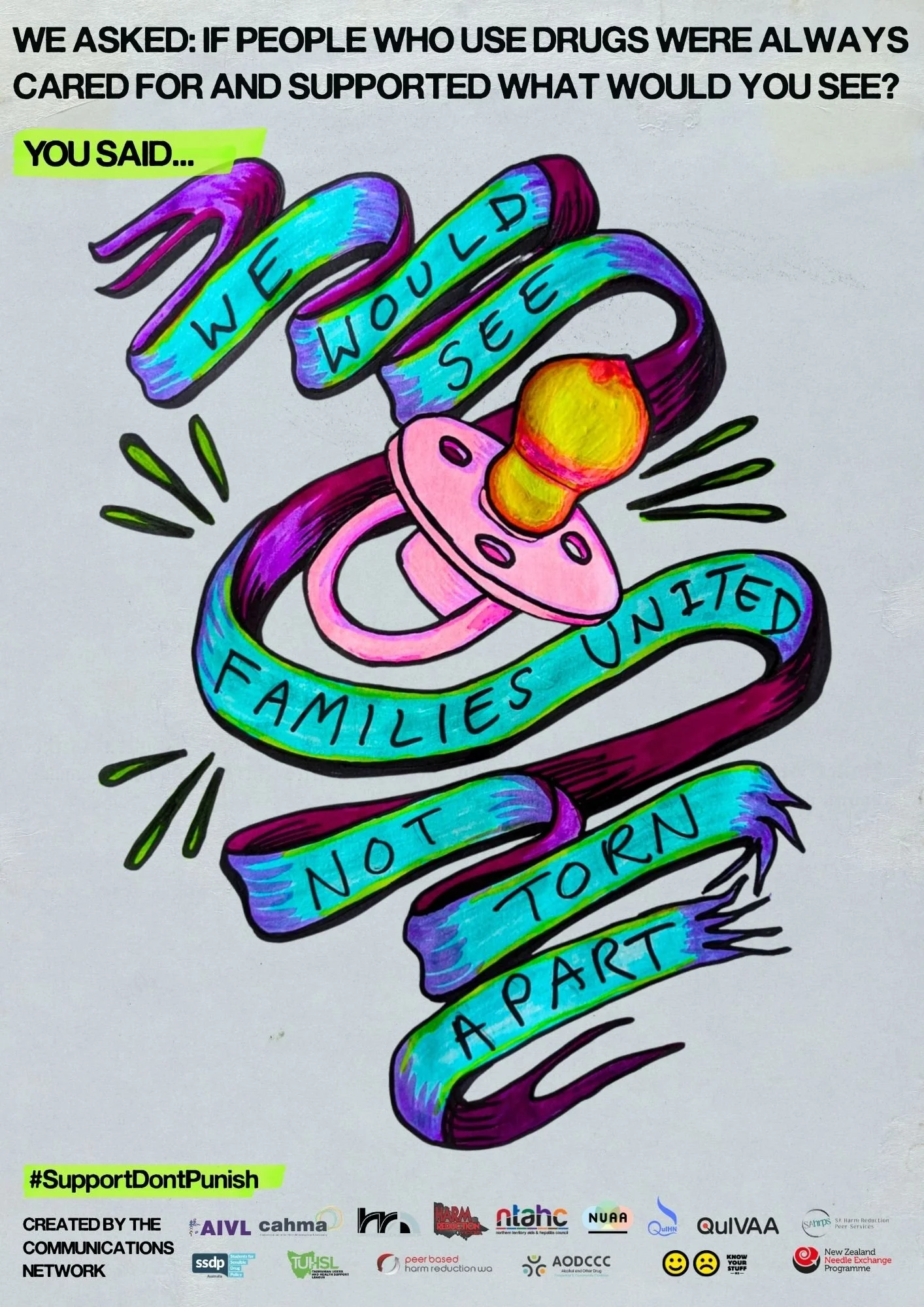
"There was one on mothers, like ‘families wouldn’t be ripped apart’. So I really wanted to do something on that. I thought, oh, what’s an icon that links to parenting? I want to do a [dummy]. There’s not much traditional tattoo pacifier art I can look at and adapt. I just do it."
None of this was in the original brief. It evolved organically as Emily worked through the submissions, let the words lead her, and trusted her instincts.
“Molly is yet to rein me in,” she laughs. “So I’m guessing it’s acceptable.”
The drawings are all hand-drawn, something Emily is passionate about, even as she’s learning digital illustration tools on the side.
There’s a directness to working by hand that she values. It’s tactile, personal, and immediate in a way that digital drawing can’t quite replicate. For a campaign that is fundamentally about human lives, that feels right.
Not every quote is easy to sit with.
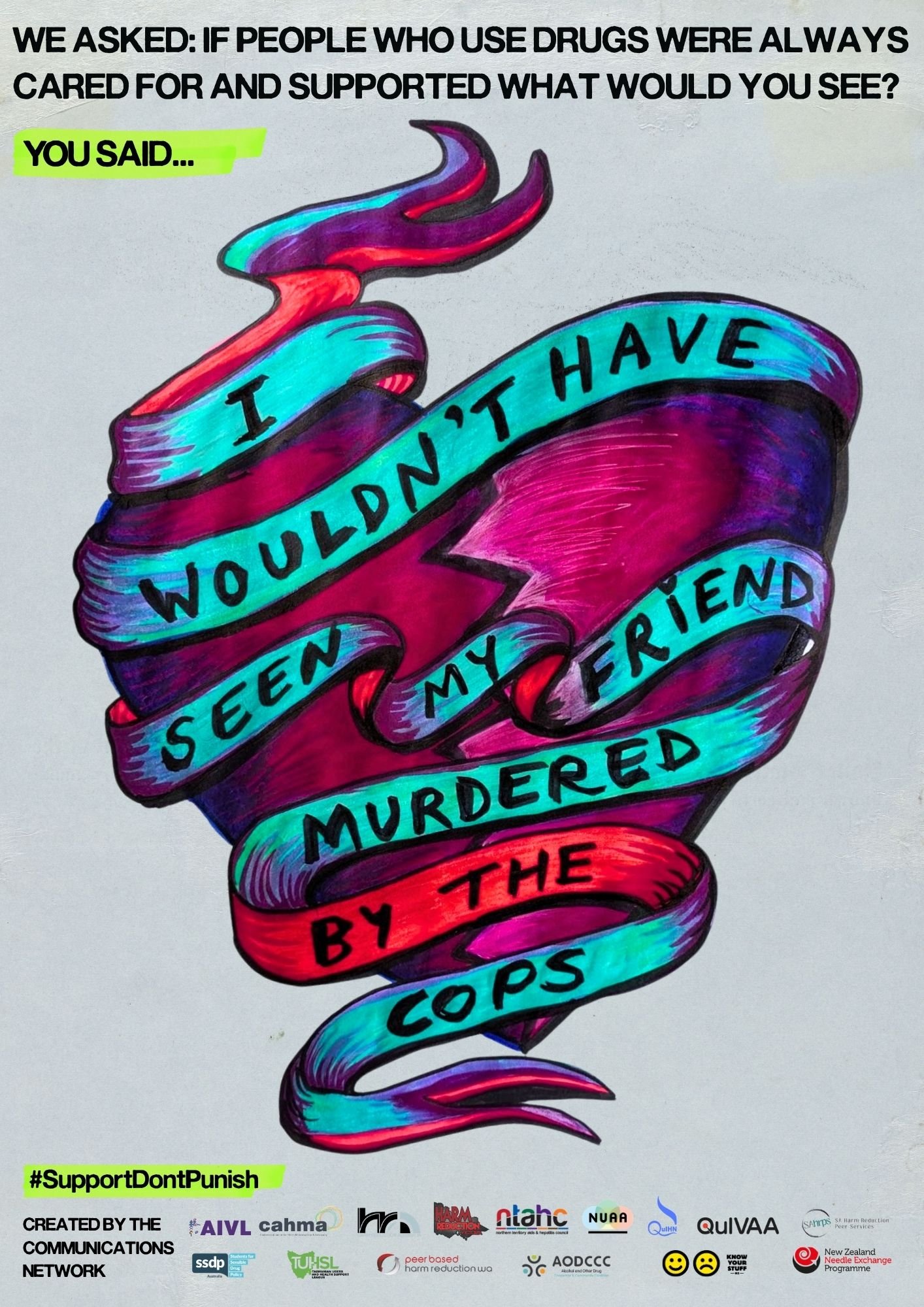
She recalls sending Molly a batch of six illustrations at once. Molly saw them all together for the first time, and her response was blunt: “F***, that’s heavy Em.”
Emily hadn’t noticed, she’d been working through them one by one, focused on the task. But together, the themes hit a lot harder.
"I didn’t realise that would just happen to be a group where it’s like... I watched my friend get murdered by the cops, and my friend wouldn’t have died suffering in pain... and then my family would have been ripped apart. That hit me too when she had that reaction."
Moments like these are a reminder of what’s at stake. The submissions aren’t abstract policy positions, they’re people’s real lives, fears, and losses, gathered from NSPs and drop-in centres across the country. The campaign’s power comes directly from that honesty.
To balance this, Emily tries to mix heavier quotes with ones that are uplifting or even funny. She also leans on her instinct for bright, bold colour, neon and vibrant tones that she’s always gravitated toward.
"I do think that’s where that balance can happen. It’s saying something, and it could look sad with like a broken heart, but the bright colours I hope kind of balance it. That’s just how I do art."
She also thinks about how the drawings are grouped on a flash sheet poster, making sure something lighter sits between the heavy ones, so people aren’t hit all at once by wave after wave of grief.
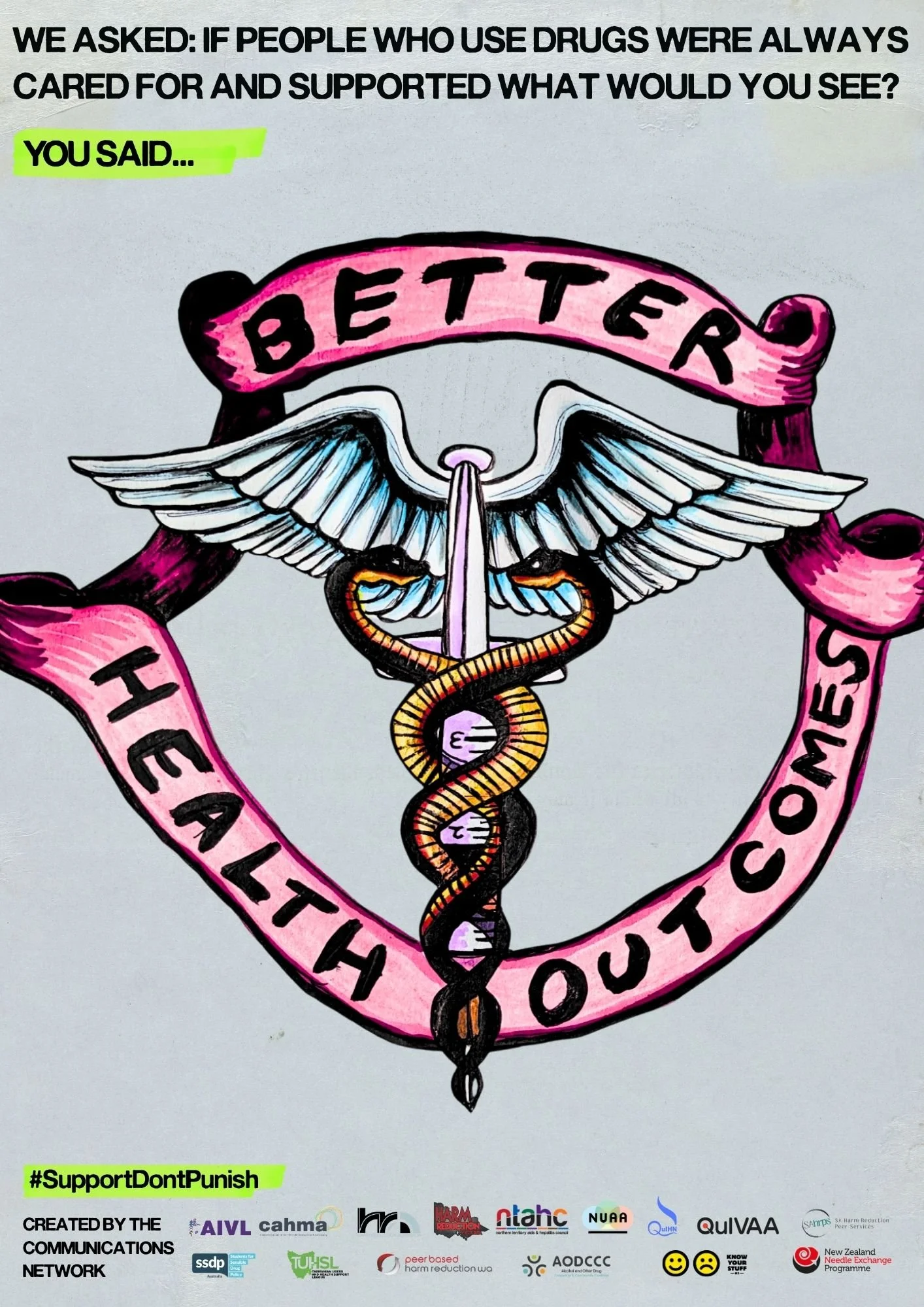
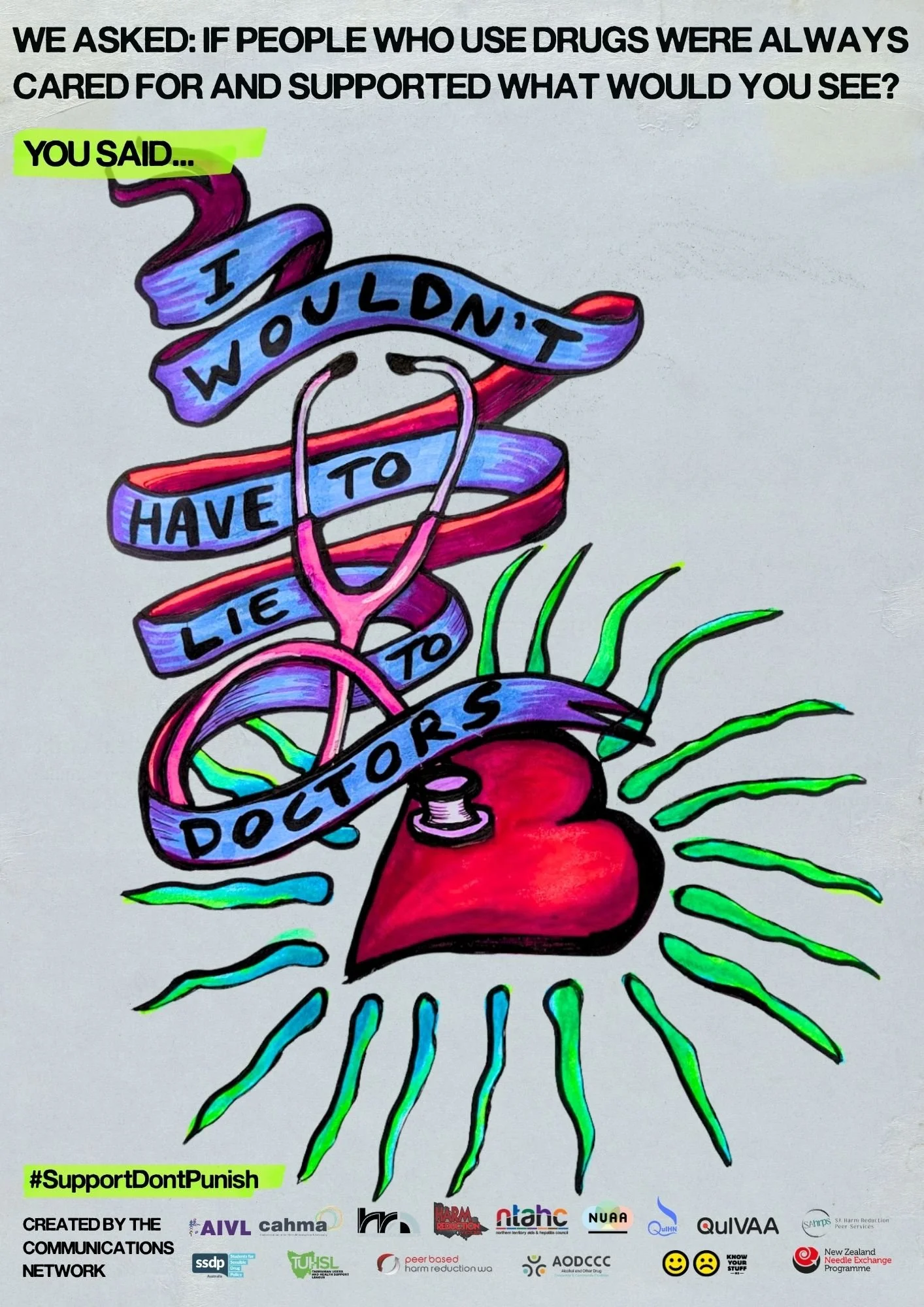
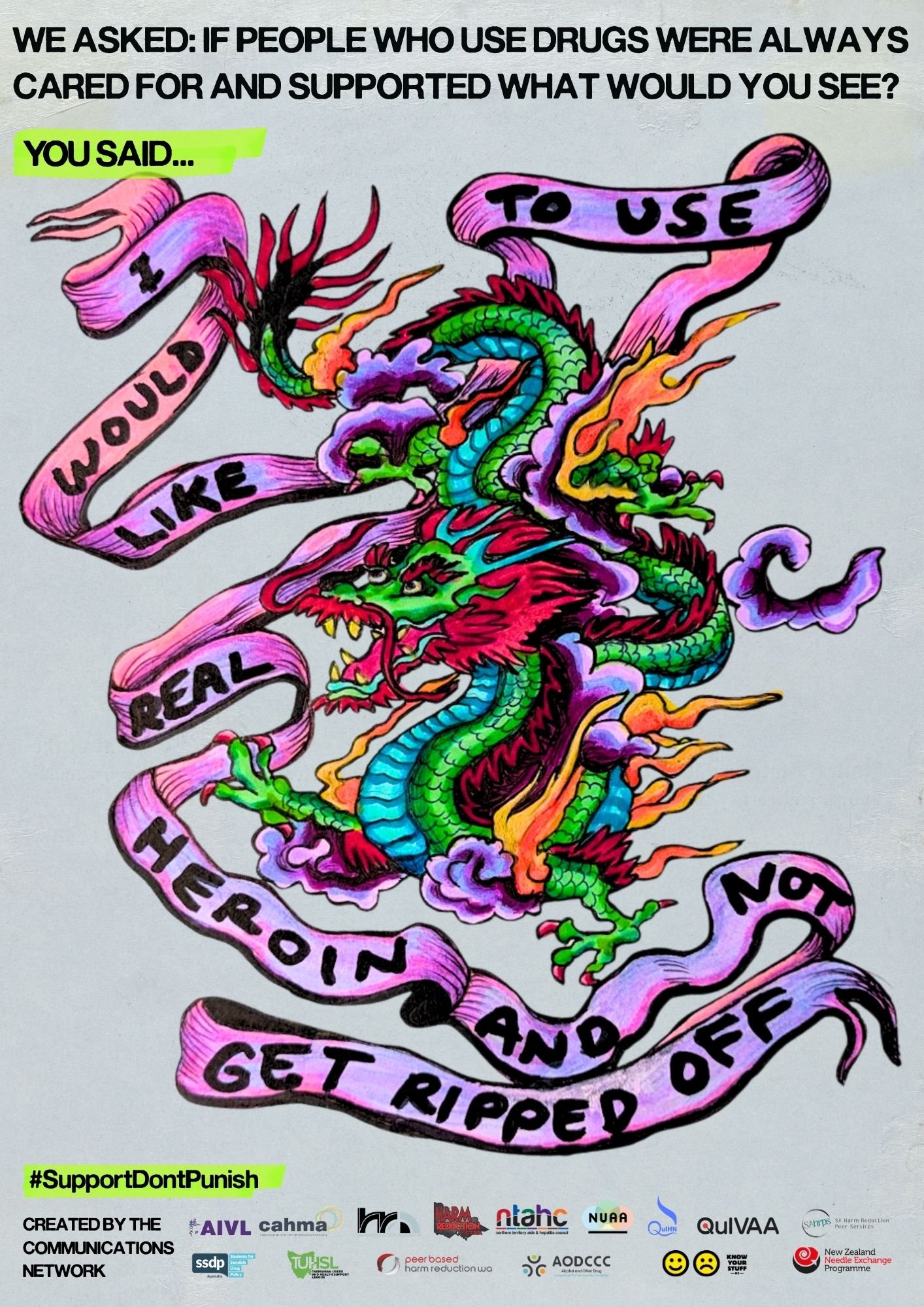
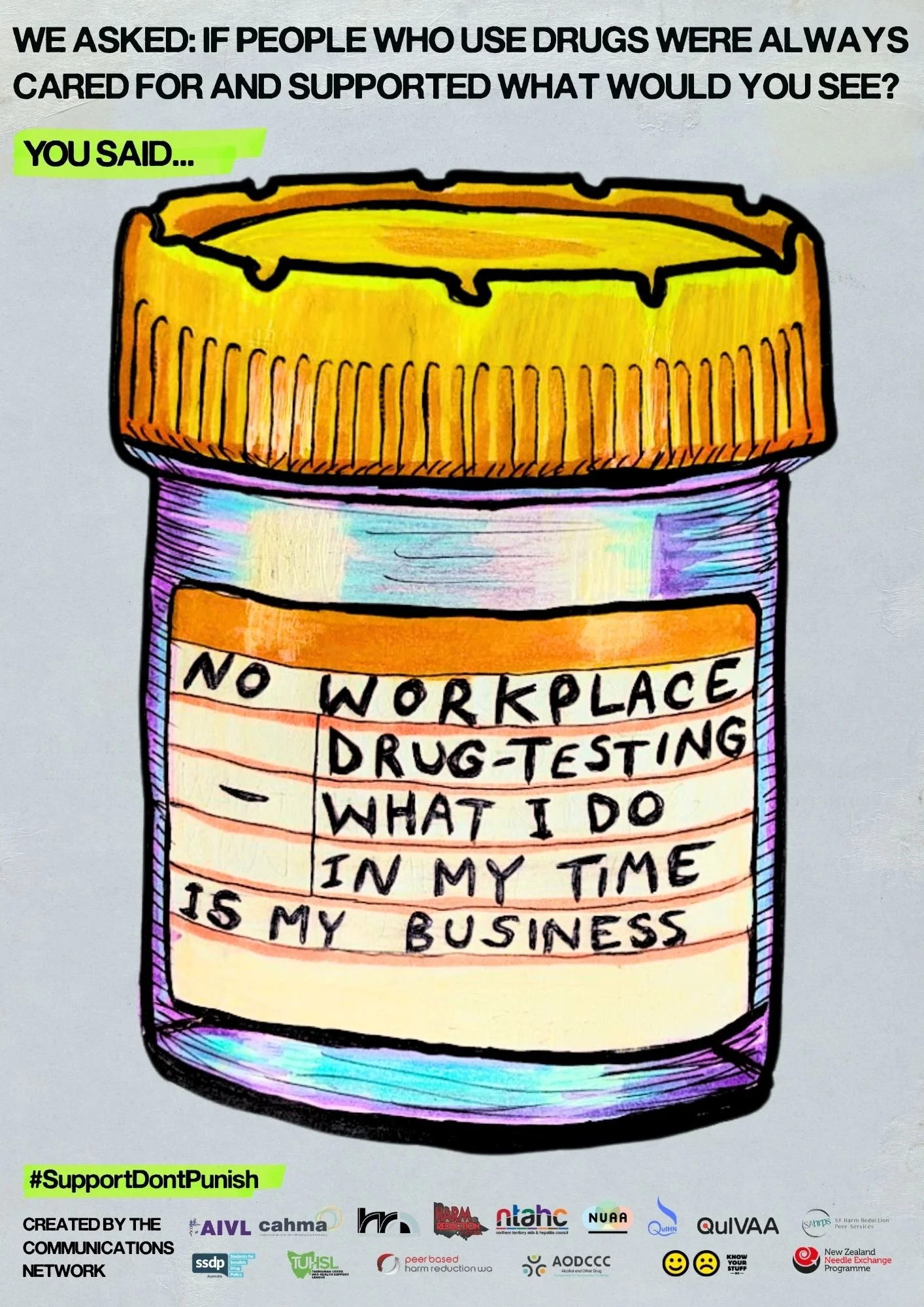
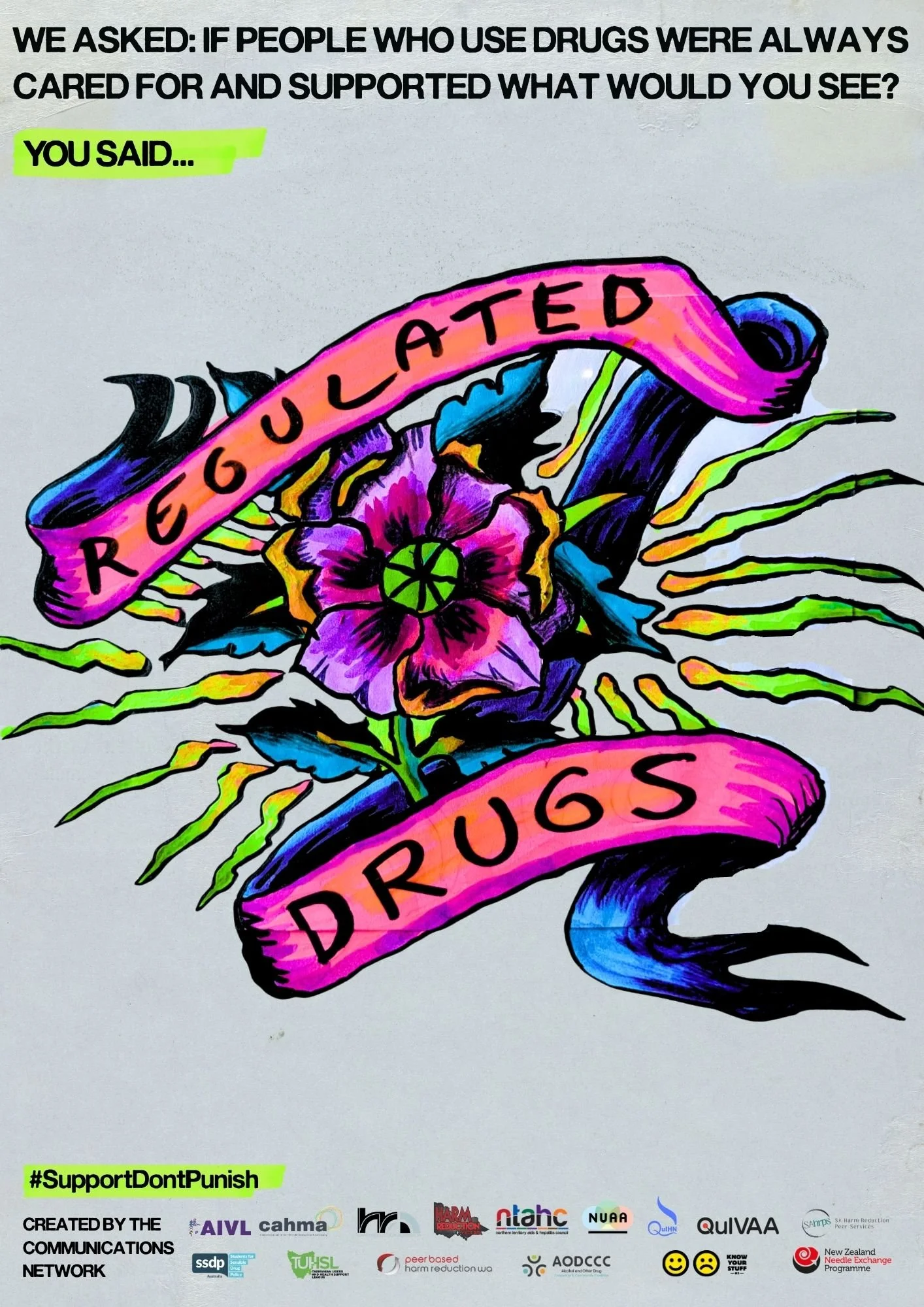
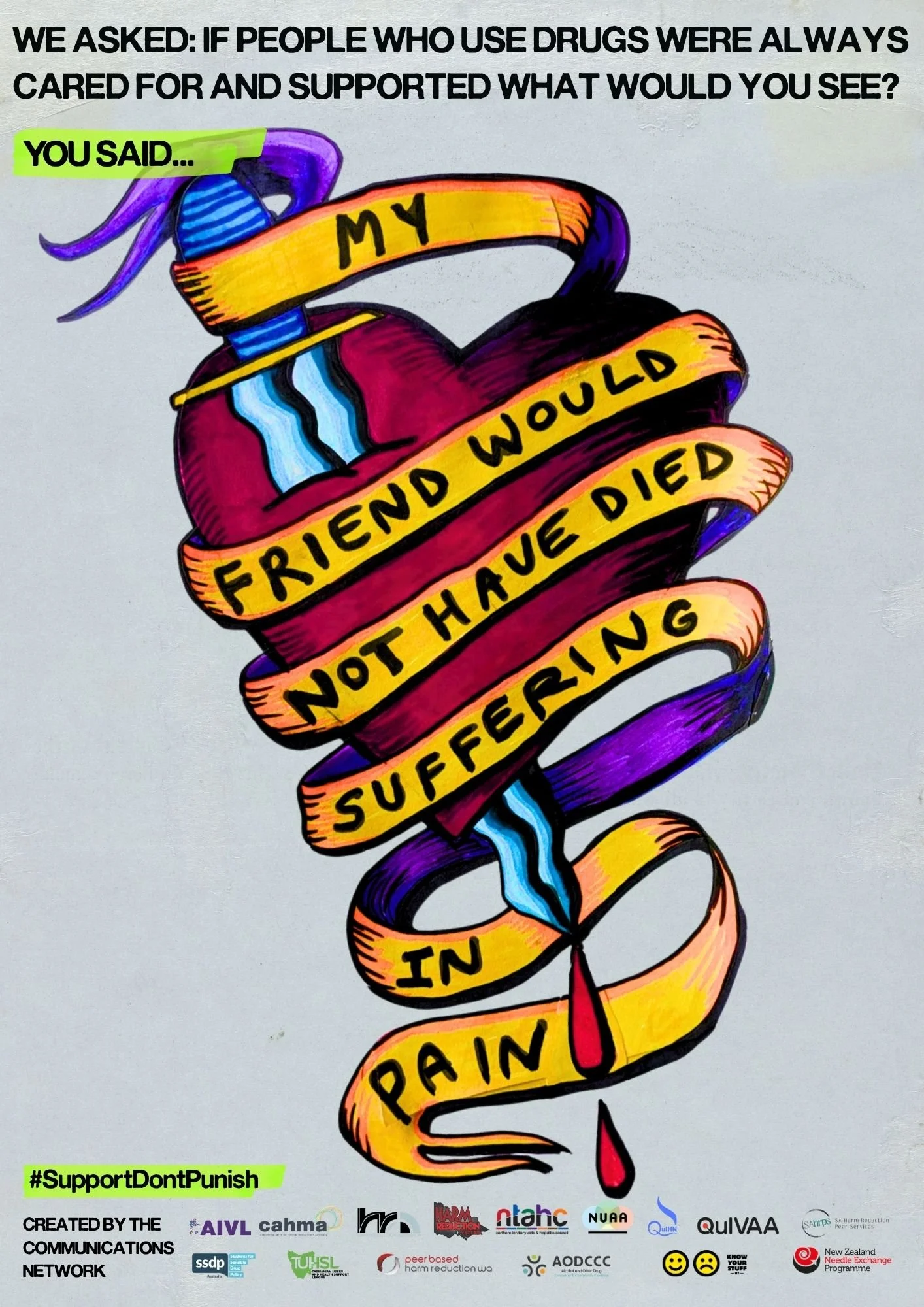
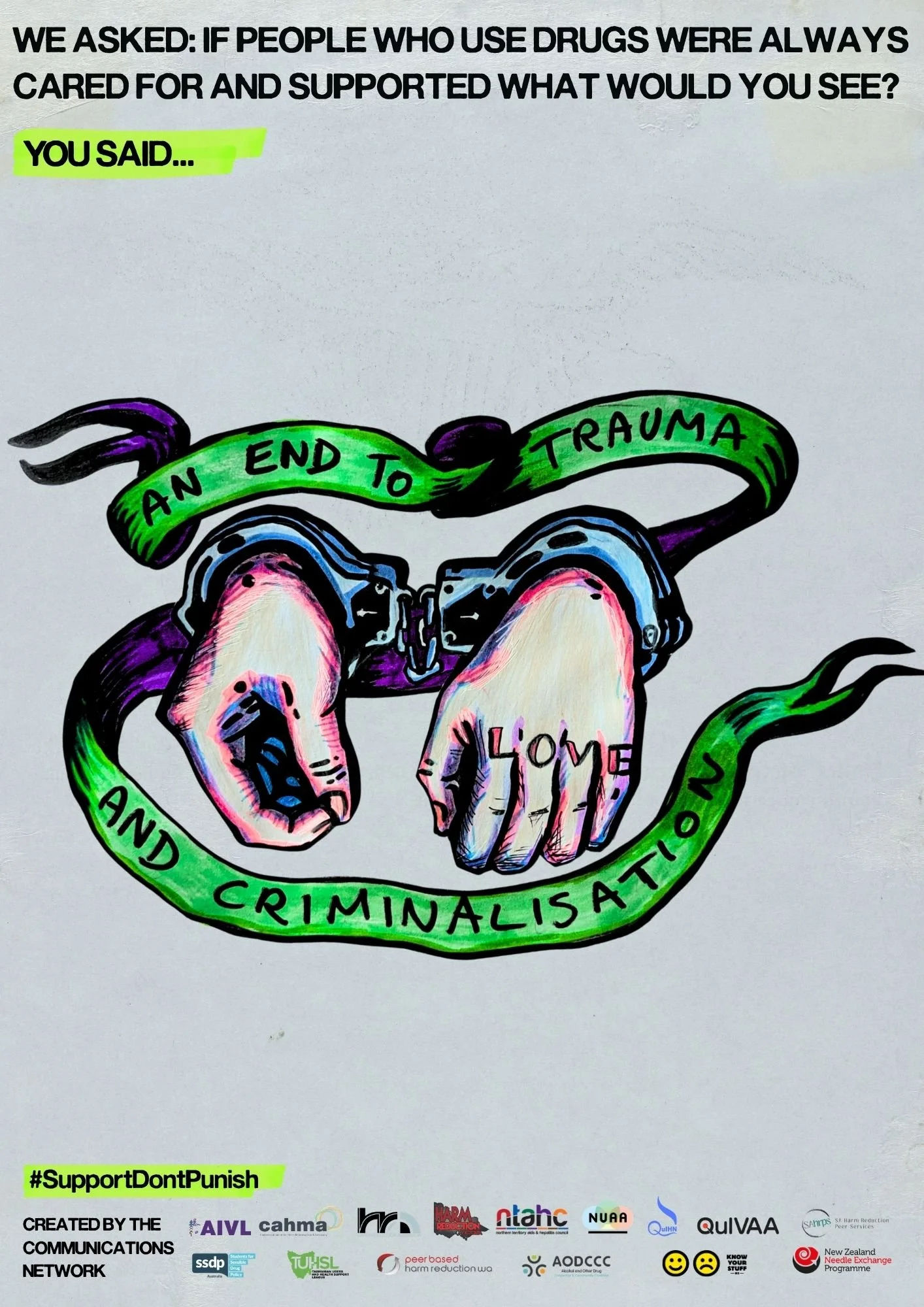
The Importance of Peer Creativity
Ask Emily what peer-created art brings to advocacy that external or commissioned work can’t, and she doesn’t hesitate.
She talks about visiting the Harm Reduction Victoria office and seeing framed peer artwork on the walls, pieces made by peers, for peers, that connected with her immediately.
She also mentions a tiny framed artwork she once spotted at CAHMA (the Canberra Alliance for Harm Minimisation and Advocacy, the ACT’s peer-led drug user organisation) during a visit there years ago.
"It was the ‘Don’t Share Care Bear’. A red Care Bear with a needle and then a cross in the belly. Just super simply done, but it’s just so good. How can you not love that stuff as a drug user? It tracks."
The kind of irreverent, culturally sharp peer art Emily describes seeing there is exactly the kind that gets remembered.
Peer artists, she says, understand the culture from the inside. They know what will land. They can push further than an outsider would dare, in ways that feel authentic rather than provocative. She draws a comparison to sex worker-led organisations, such as Scarlet Alliance, Australia’s national peak body, that produce similarly boundary-pushing comms.
She says simply, “peers reach peers.”
There’s a strong tradition of this kind of work in social movements more broadly.
Zines, placards, screen-printed posters, stickers slapped on walls, the aesthetics of grassroots advocacy have always had a DIY roughness to them. They come from communities with no budget and everything to say.
The harm reduction movement has always sat comfortably in that tradition.
"I feel like we can sometimes go a bit further than other comms people, keeping true to the more DIY roots of activism and art."
With SDP specifically, Emily sees the AIVL network’s version of the campaign as something genuinely special. A non-peer campaign that has been reclaimed and made meaningful through peer participation at every single level.
"You can’t get more of a peer hijack of a non-peer led campaign. Current, living drug users in their NSP, telling us what they think, and it being realised. You can’t get more peer than that."
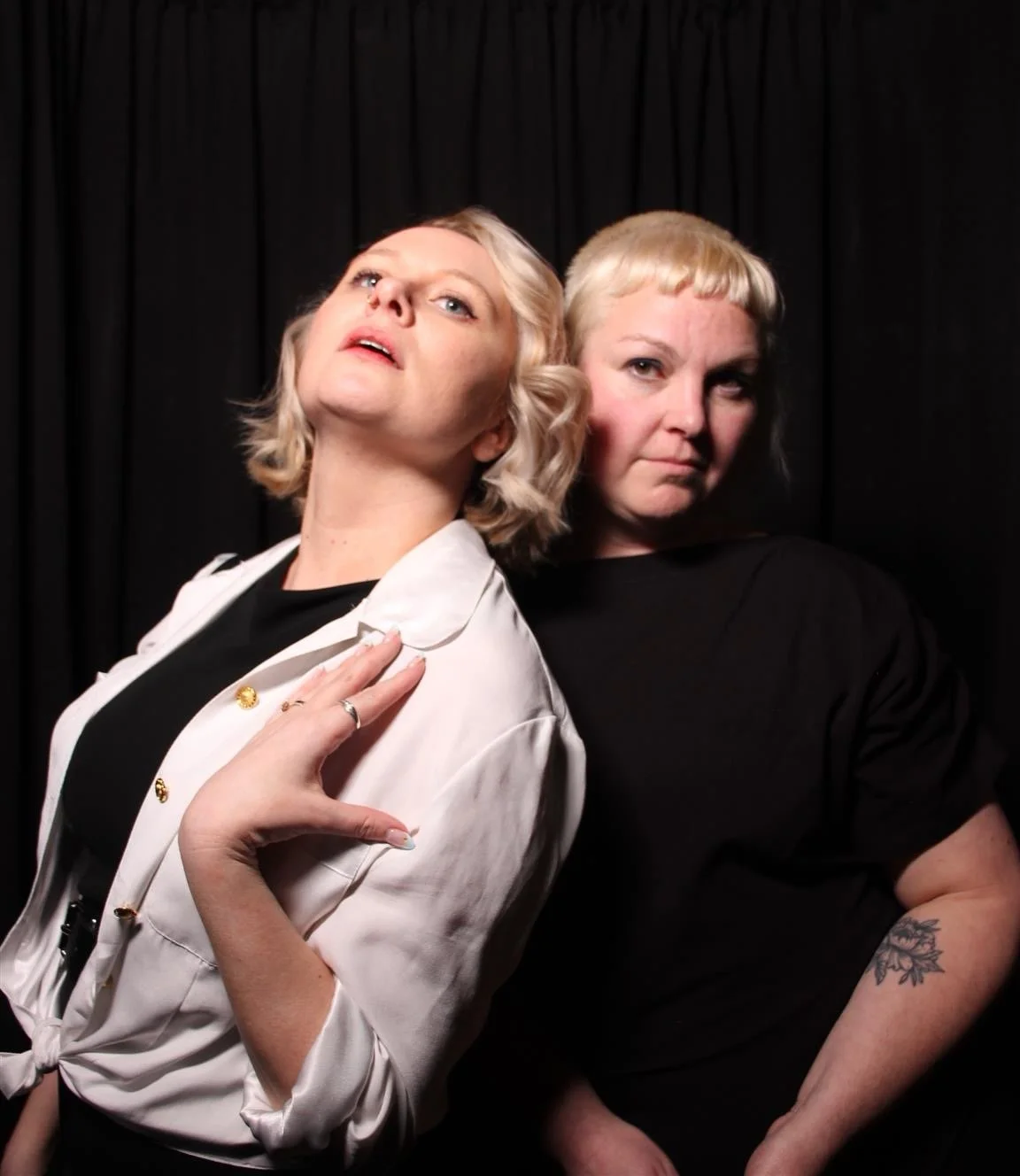
Emily & Edie, NUAA’s Comms & Media Lead
Emily is quick to share the credit.
The illustrations might be hers, but the campaign runs on the effort of a whole national network. The peer workers and NSP staff who sit down with clients and collect responses, the DUO comms teams who spread the word, and collaborators like Molly who shape the creative direction.
“Yes, there's this little team of me and Molly, but then there’s the big village that makes that happen nationally. Because I wouldn't have anything to draw if people weren't out there collecting the answers.”
That village includes organisations like NUAA, HRVic, CAHMA, TUHSL, SSDP, and other DUOs across every state and territory. Each one has people on the ground, in NSPs, at drop-in centres, and outreach programs, asking the questions, listening to the answers, and passing those voices on.
Working on SDP has also changed how Emily thinks about her art more broadly. The combination of a strong quote, a simple image, and a bold visual style has proven so effective that she’s started applying the formula in other areas of her work with TUHSL.
She now uses illustrated quotes on promotional postcards for TUHSL’s Peer-Based Harm Reduction Prison Program, pulling from participant evaluations to highlight what people have said about it.
"They’re like, oh, like that’s what another person said about it. So it sort of verifies that it’s a good program, hopefully.
“And then on top of that, I’ve noticed some of my participants deliberately writing feedback that they want turned into an illustration."
One participant even slipped an obviously quotable line into her evaluation form, knowing Emily would spot it. That kind of feedback loop, where the community starts actively shaping the comms, is exactly what peer-led work is supposed to look like.
Why It Matters
Support Don’t Punish is now one of the world’s largest drug policy reform campaigns.
Its Global Day of Action has been organised in over 2,300 locations across more than 110 countries since 2013. The campaign’s message, that drug policy should be rooted in health and human rights, not punishment, remains urgent.
In Australia, some progress has been made. The ACT decriminalised personal drug use in 2023. Drug checking services are being piloted and assessed. But NSP funding remains tight, stigma remains rife, and the punitive logic that drives people away from services rather than toward them is still very much with present.
Looking at Emily’s illustrations, it’s easy to see why they resonate. They don’t look like something made in a boardroom or designed to a corporate brand guide. They look like something made by someone who has spent years sitting across from people, listening to them, and fighting for them, which is exactly what they are.
This year, Support Don’t Punish takes place on Friday 26th July. To see Emily’s artwork and learn more about the campaign, visit AIVL’s website or follow the #SupportDontPunish hashtag on social media.